Every new segment of Episode 4 was kept on its first take, because where each one starts and ends was drawn before we shot it.
By Louis Chi · · 7 min read
- episode, 21 cuts
- 36.7 s
- new segments, one take each
- 6
- of video generation
- $2.77
- clips refused by fal, all refunded
- 3

Made with
- Studio
- RefVid
- Video model
- Kling 3.0 Omni, 9:16, 720p, sound off; six new segments of 3 to 10 s, two reused from a first attempt
- Keyframes
- An image model, 11 frames: 3 reused, 8 new first and last frames, 24 image calls
- Sound
- 28 CC0 sound effects and a courtyard ambience. Music: Beethoven, Symphony No. 6, performed by Musopen
GuaPi Episode 4 is 36.7 seconds long. Six of its eight segments were generated new on Kling 3.0 Omni, and all six were kept on the first take: $2.77 of video generation, against a cap of $5.
That was not luck. Before anything was shot, the script went through three rounds of review, every segment got a drawn first frame and, where the ending mattered, a drawn last frame, and a reader who had never seen the script retold the story from those stills alone. The model only had to act out the middle. The three clips fal refused were refused for limits of Kling 3.0 Omni that nobody had written down, and the studio now handles them for everyone.
A reason on screen for every beat
The first script was 18 shots of 3 seconds: nine story shots, four one-second reaction close-ups and five rounds of running away. Six of them were shot on October 25. Then it stalled, because three whys were invisible: why the cloud rains only on GuaPi, why Henry switches on his fan umbrella, and why the vegetable patch ends up watered.
The rewrite is eight segments, 39 seconds as written, and each why became something you can see. The cloud's tail is tied round the knob on GuaPi's head, so it follows him. Henry tries to blow it off him into the patch, so the fan comes on. The umbrella walks GuaPi into the patch, so the rain lands there. The chase moved to the open yard, the eaves and the sleeping dog, because the water vat and the bamboo table were Episode 3's.
A second assistant read the script only to find holes: 13 in the first round, 10 in the second, 9 in the third. The director then made the last edits himself, and the reviewer checked only those, twice, until it passed. An outside check suggested one more drawn last frame, for segment 8, which has to shrink the cloud, show a rainbow and make GuaPi smile in 3 seconds.
Kling first and last frame: draw where each segment ends
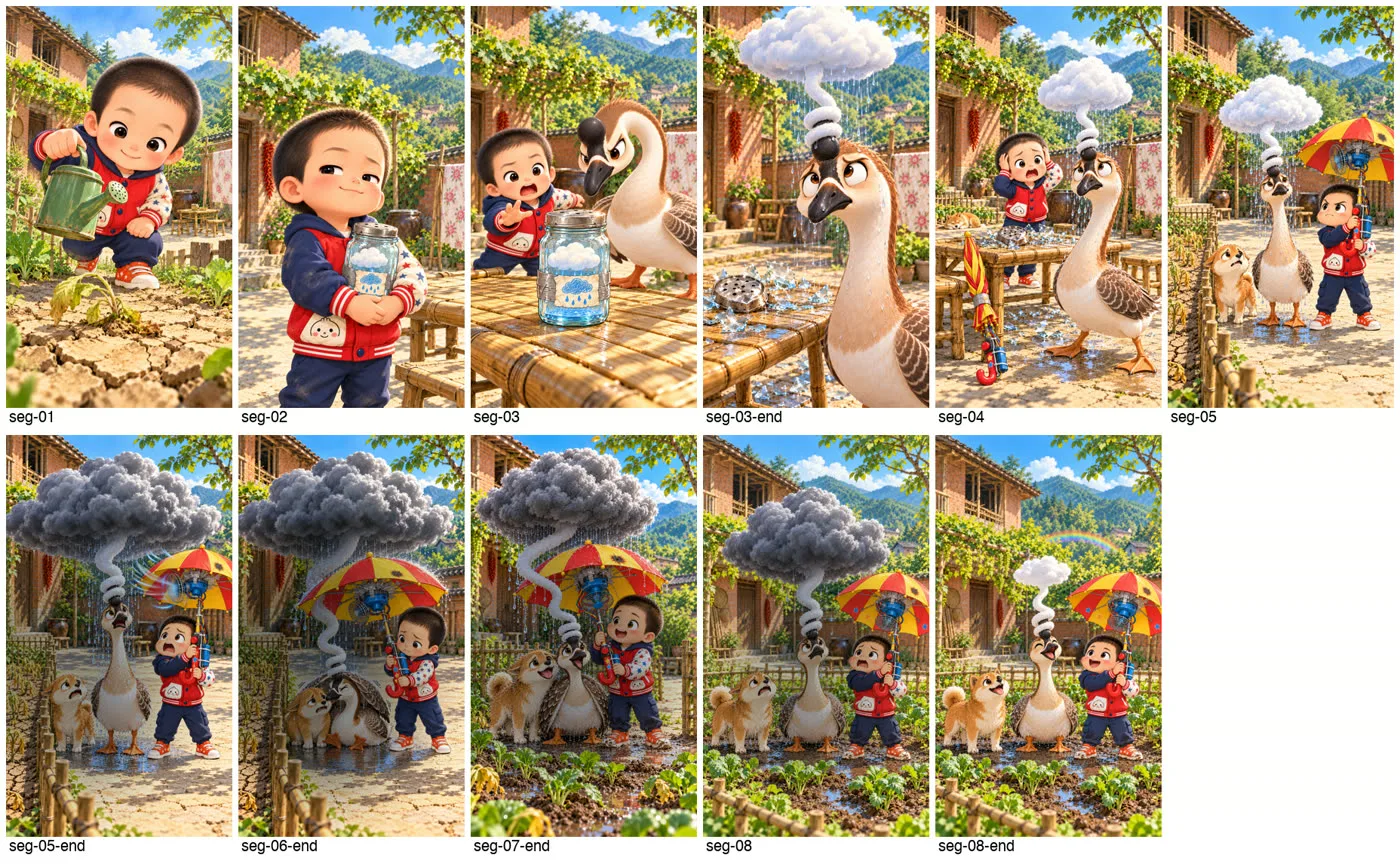
Episode 4 has 11 drawn frames. Three were copied from the first attempt; eight are new: three first frames and five last frames. Segments 6 and 7 start on the last frame of the clip before them, and their drawn last frames still mattered: they kept the animatic continuous and fixed two things the story needs, the umbrella over GuaPi's head and the patch turning green.
Every new frame was drawn twice and the better one kept, 24 image calls in all. The ones sent back had the patch filling the whole foreground instead of the left side, or the cloud's tail passing through the umbrella. In the shoot, every segment with a last frame ended almost exactly on the drawn picture.
A reader who had never seen the script
The 11 frames were cut into a 39-second animatic of stills. A fresh assistant got only a sheet of it, one still every 2 seconds, and was asked what happens. It told back the beats in order: the drought, the jar, the goose smashing it, the cloud tied to his head, the fan turning it into a storm, shelter under the umbrella, the patch turning green, the small cloud and the rainbow. What it missed were the actions themselves, the smash, the chase and the walk, which are the clips' job.
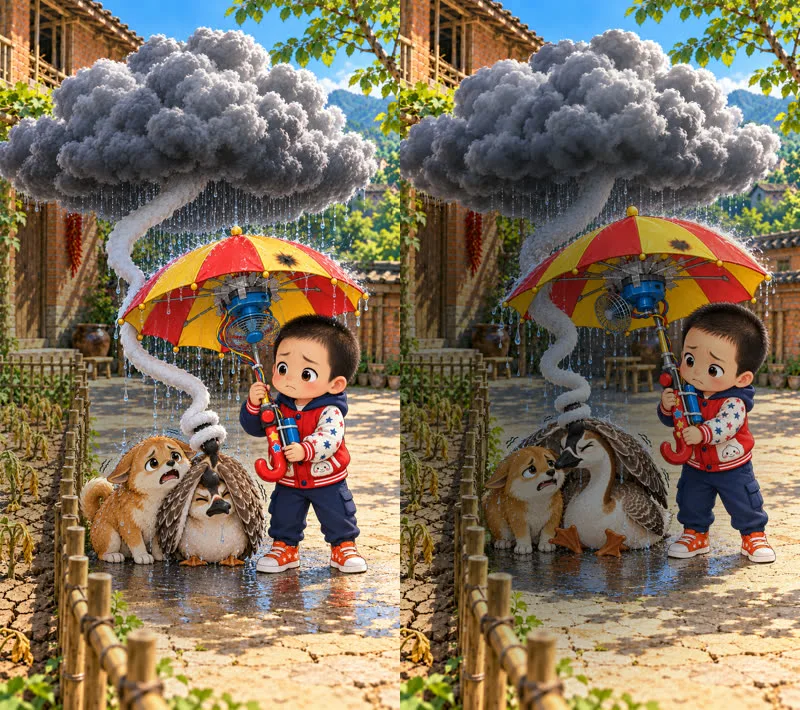
It found one real problem: in the last frame of segment 6, GuaPi curled up in fear looked like a hedgehog. The redraws came back as a ball twice more and once with no clear neck; the fourth showed the long neck, white face, black bill and knob, and orange feet.
Three Kling 3.0 multi shot limits nobody had written down
fal refused three clips before rendering, and the credits came back each time. Its published schema only says the whole prompt can be 2,500 characters. None of these three limits is written anywhere.
| What fal said | The real limit | What RefVid does now | Credits |
|---|---|---|---|
| "Prompt must not exceed 512 characters" (two shot boxes of 616 and 677) | Each shot box takes at most 512 characters | Each shot box is capped at 480; if one still passes 512 as sent, the shots go in as one prompt, in order | 155, refunded |
| "End Image Url is not supported with Multi Prompt" | Several shot boxes cannot take a last frame, only a first frame | With a last frame set, the shots are merged into one box: "Shot 1 (3 s): … Shot 2 (2 s): …" | 155, refunded |
| "multiPrompt[2].prompt: size must be between 0 and 512" (471 characters, 7 character names) | The 512 is counted after the model expands each character name, at least 6 more characters per name | A shot plus 8 characters per character name over 512 is merged into one prompt | 310, refunded |
The first two fixes are in the studio itself, so they hold for everyone who uses Kling 3.0 Omni in RefVid, not only for this episode. All three are also in the script compiler, so the next episode is stopped at the check, before anything is sent.
One prompt box: two shots and a drawn last frame
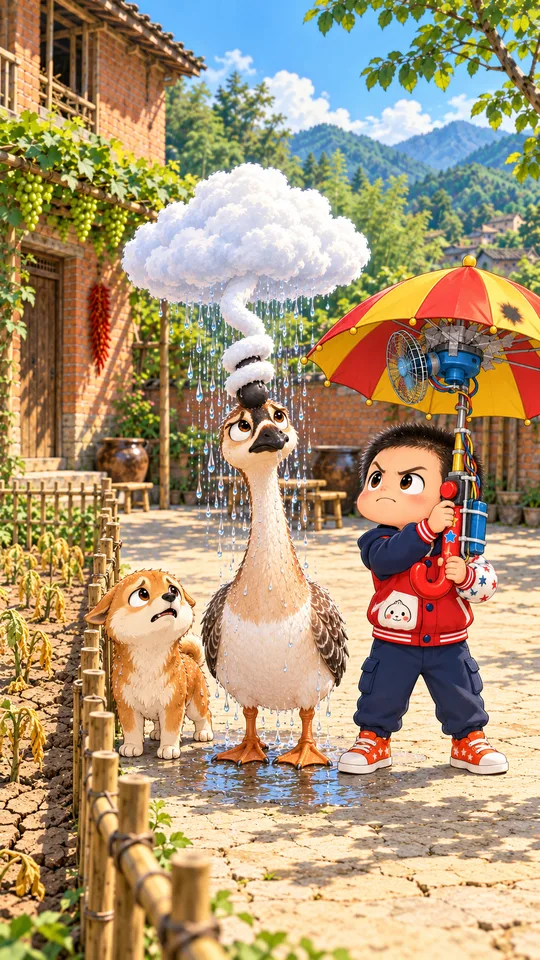
Segment 5 has two shots and a last frame, so it went in as one box. Both ends were drawn, so the model only had to play the part in between. It held the camera still, blew the cloud off the left edge until the tail went taut, snapped it back over GuaPi as a storm cloud, and ended almost exactly on the drawn last frame.
- Shot
- Segment 5, the fan umbrella
- Characters
- Henry, GuaPi, Xiaobai
- Settings
- Kling 3.0 Omni · 5 s · 9:16 · 720p · sound off · drawn first and last frame · $0.42
Shot 1 (3 s): medium: Henry presses the red button and the fan umbrella blows the white cloud left toward the patch until its thick tail stretches taut from GuaPi's knob; Henry's set jaw turns hopeful, eyebrows up. Shot 2 (2 s): medium: the taut tail snaps the cloud back over GuaPi and it swells into a dark storm cloud raining from its underside onto him; Henry gapes in horror, GuaPi's eyes go huge with fear. Fixed camera. Keep the drawn style. Lock: There is only one goose in this shot. Henry on the right, feet on the ground; the cloud's thick white tail stays looped round GuaPi's knob; exactly ONE fan umbrella upright in Henry's hands; exactly ONE dark storm cloud right above GuaPi's head.
What the edit fixed
Keeping every first take did not mean every first take was right. The edit went through all the footage frame by frame, the four old clips and the six new ones, and cut by the action: 21 cuts, 880 frames. Still moments were sped up and moments too quick to read were slowed down. Three places needed more than that.
Three rounds of rain in one segment
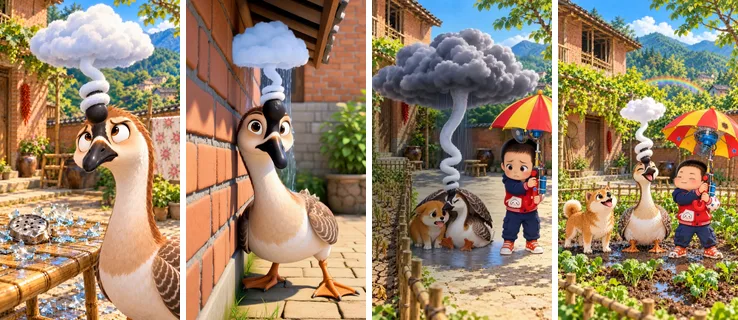
The chase is one 10-second segment with three shot boxes: across the open yard, flat against the wall under the eaves, and behind the sleeping dog. Each round ends the same way, with the cloud right above him and the rain coming down, which is the joke.
Sound, placed by the frame
The clips were generated without sound. Every sound in the episode is one of 28 CC0 effects placed on its frame: the water from the can, the glass breaking, wet footsteps, the fan, the twang as the tail snaps the cloud back, thunder, rain on the umbrella, water soaking into the soil. A courtyard ambience runs under the whole film.
The music version adds Beethoven's Sixth Symphony, the Pastoral, in a public-domain recording. It stops on the thunder clap and comes back when the patch turns green. Music: Beethoven, Symphony No. 6, performed by Musopen.
Four stages
- First attempt18 shots of 3 seconds, six of them shot. The reasons behind the story were not on screen. Four clips were kept for the final cut.
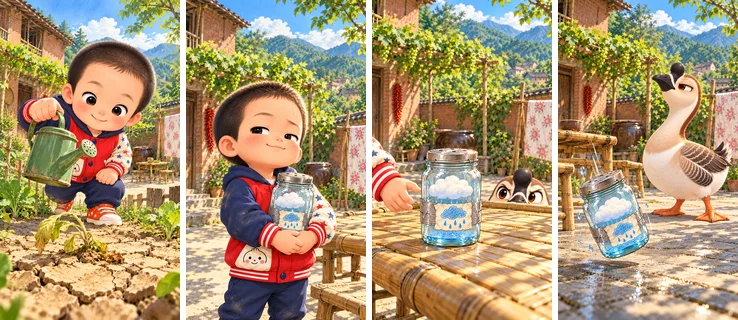
- Script v2Eight segments, three rounds of review, and a drawn first or last frame wherever a segment starts or ends somewhere new.
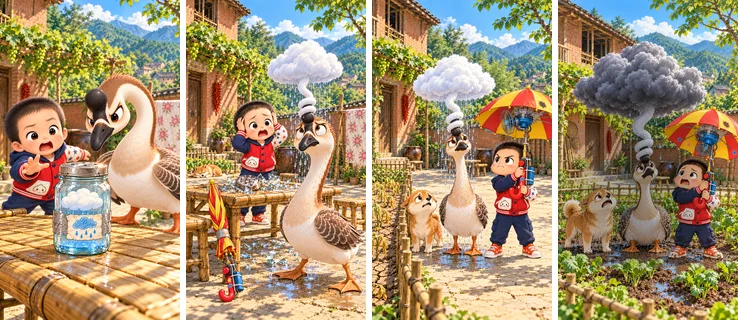
- Animatic39 seconds of stills, retold by a reader who had not seen the script. One frame redrawn: the goose that looked like a hedgehog.
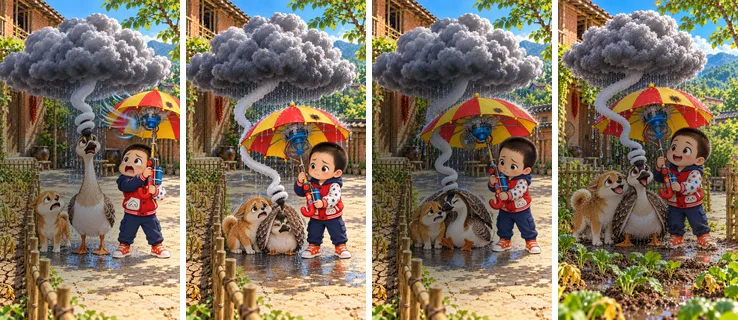
- EpisodeSix segments, each on its first take, cut into 21 shots. 36.7 seconds.
What is still weak
The seedlings never stand up one by one. A last frame shows only the end state, so the 2-second shot opens on a patch that is already green; the change happens in a dissolve. A change the viewer has to see needs its starting state in the picture, as a first frame or in a longer shot.
Henry's moment of understanding does not read: his look over at the patch is unclear, and he simply smiles and walks in. The dog waking up in the rain was cut because GuaPi is hidden behind him in those frames, and the cloud shrinking at the end lasts six frames, slowed to half speed to be seen.
What it cost
$2.77 for the six new segments, each kept on its first take. The four old clips reused from the first attempt had cost about $1.76 together with the three that were not used.
| Step | What we generated | Generation cost |
|---|---|---|
| First attempt, October 25 | 7 clips of 3 seconds on Kling 3.0 Omni; 4 are in the episode | ≈ $1.76 |
| Segments 3 to 8 | 6 clips, 33 seconds, one take each | $2.77 |
| Three refused clips | Stopped by fal before rendering | $0, refunded |
| Frames | 24 image calls for 8 new frames | No video cost |
What we check before the next episode
- 1Draw the first frame wherever a segment starts somewhere new, and a last frame wherever its end matters.
- 2Let someone who has not read the script retell the story from the animatic.
- 3On Kling 3.0 Omni, keep each shot box under 480 characters, and send a segment with a last frame as one box.
- 4Put the starting state of a change on screen, not only its end state in the last frame.
- 5Reuse every usable take from earlier attempts before generating new ones.
Questions
- How do you use Kling first and last frame in one clip?
- Upload the picture the clip starts on as the first frame and the picture it has to reach as the last frame, then describe only the action in between. In Episode 4 every segment with a drawn last frame ended almost exactly on it.
- Can Kling 3.0 multi shot take a last frame?
- Not as separate shot boxes: fal refuses a last frame together with several shot prompts. RefVid now merges the shots into one prompt, "Shot 1 (3 s): … Shot 2 (2 s): …", when a last frame is set, and the model still cuts between them. Segments 3, 5, 6 and 7 were made that way.
- How long can a Kling 3.0 Omni shot prompt be?
- 512 characters per shot box, counted after each character name is expanded, so leave room. RefVid caps each box at 480 characters and merges the shots into one prompt when a box would still pass 512. The whole prompt can be 2,500 characters.