The characters were never the problem. Episode 3 was thrown away twice because the story did not hold together.
By Louis Chi · · 7 min read
- segments in the episode
- 8
- clips generated
- 32
- versions
- 9
- of video generation
- ≈ $16

Made with
- Studio
- RefVid
- Video model
- Kling 4, 5 s per segment, 9:16, 720p (a first version on Kling 3.0 Omni was thrown away)
- Keyframes
- An image model, 2 pictures; every other segment starts on the last frame of the one before
- Sound
- CC0 sound effects and courtyard ambience, a public-domain recording of Tchaikovsky's Sixth Symphony
GuaPi Episode 3 is 36 seconds long. Henry, Alice and Xiaobai look like themselves in every frame, because they are the same saved characters as in Episodes 1 and 2.
What went wrong was the story. The first version had 16 short shots, a projector on a bedsheet and a chase with no reason behind it, and nobody could follow it. We rewrote it as one line a child can retell: the popsicle is gone, the dog follows the drips, it was the sister, they share it. This article shows what that rewrite changed, the retakes side by side, and what it cost.
Write the story before the shots
The first script was written to a checklist: 12 to 16 shots, a fight of three to five rounds, a warm ending. It met every number and told no story. A translator collar projected memories onto a bedsheet, the chase started for no reason, and the ending had everyone laughing for no reason either. We shot all 17 clips, cut it, and threw it away.
The rewrite started from one sentence and only then became shots. Every beat has a reason the viewer can see: the box is empty, so Henry wants the thief; the dog follows the drips, so it finds Alice; she still holds half the popsicle, so she runs; she is caught, so she shares. Before any picture was drawn, a second assistant read the script only to find holes, and it took eleven rounds before it found none.
AI video continuity: each segment starts on the last frame of the one before
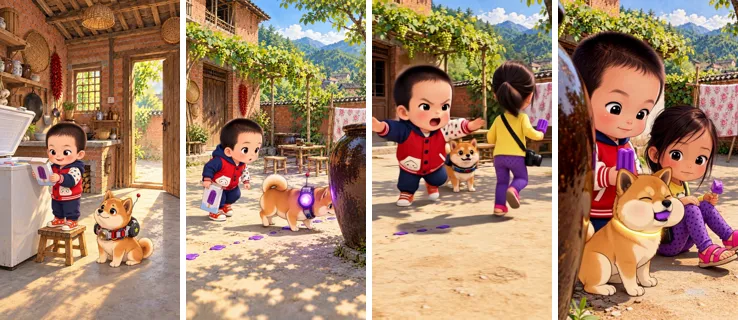
Instead of 16 three-second shots, Episode 3 is six five-second segments on Kling 4, plus two chase rounds added later. Only two segments have a drawn first frame: the kitchen, and the moment the trail leads behind the water vat. Every other segment begins on the last frame of the clip before it, so where people stand, what they hold and the afternoon light carry straight across the cut.
Five seconds is long enough for one whole beat, such as finding Alice behind the vat, without cutting away halfway through. It is not long enough for two beats, and every time we asked for two, one of them came out wrong.
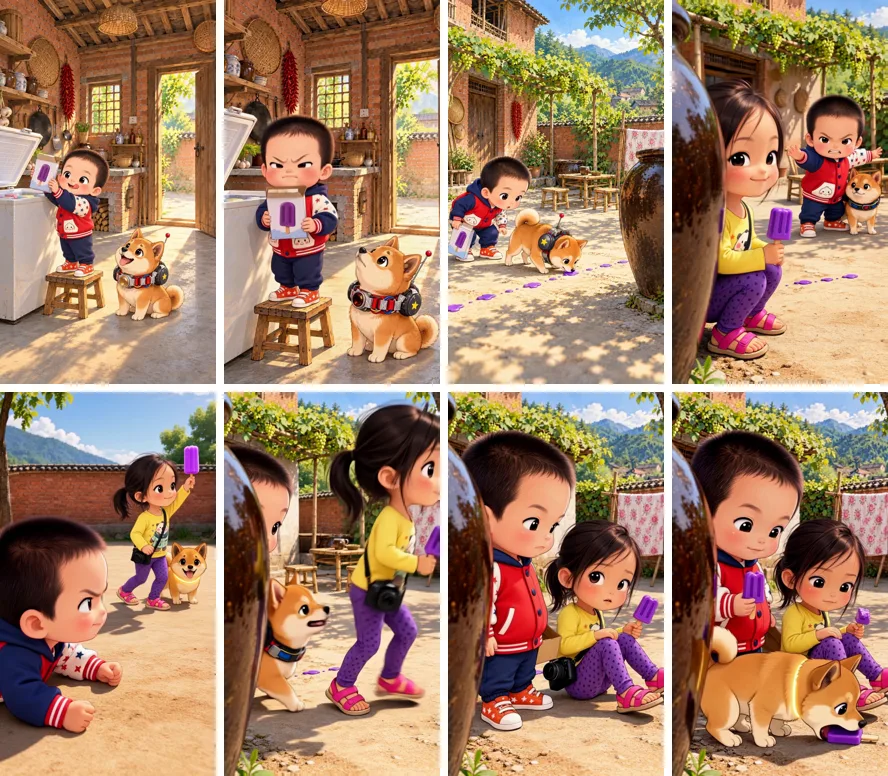
Four retakes, and what each one fixed
Each retake answered a question a viewer would ask. How did the dog know it was her? Did she just fall over? Why are there three popsicles? Where did the piece go?
A Kling AI animation prompt that shows the action step by step
Asked to "gobble up the piece", the model went straight to the result. Writing the action as numbered steps, each one something you can see, gave every step its own second on screen.
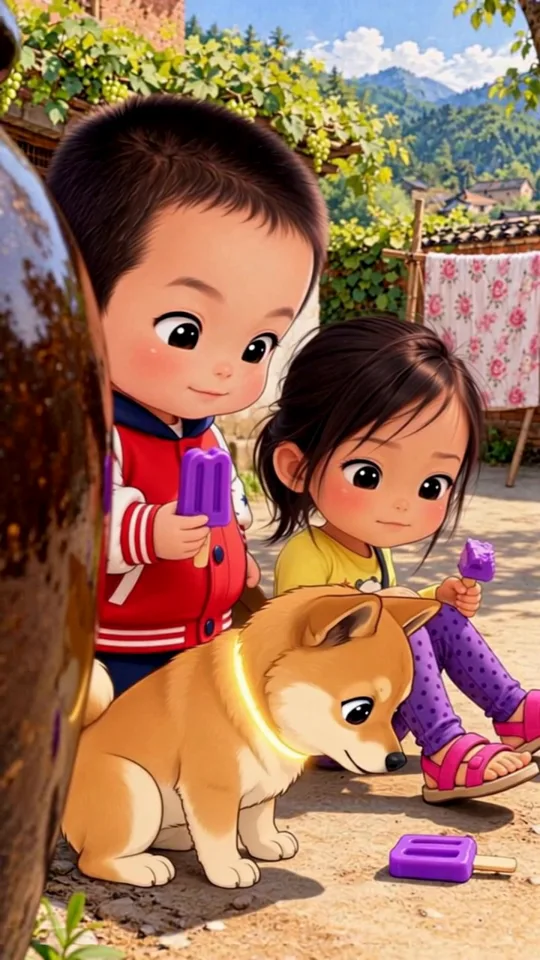
- Shot
- Segment 6, the last piece
- Characters
- Alice, Henry, Xiaobai
- Settings
- Kling 4 · 5 s · 9:16 · 720p · last frame of segment 5 as first frame
Step 1: Xiaobai picks up the purple piece from the ground in his mouth. Step 2: he chews it, munch munch munch, cheeks puffing in and out, the purple piece still visible between his teeth while he chews. Step 3: the cold makes him squeeze his eyes shut and shiver for a moment. Step 4: he swallows with a big gulp, then sticks out a tongue that is now bright purple. Henry's small smile turns into giggles and Alice laughs; both take a bite of their own popsicle piece. All three stay in frame, same sizes; the camera holds still. No one talks. Keep the drawn style.
A chase needs rounds, not one grab
In version 5 Alice ran two steps and was caught, and the episode was 28 seconds. Two more segments became two rounds: she bolts and Henry dives into the dust; she doubles back around the bamboo table and Henry overshoots. Then the grab on her leggings ends it. The episode grew to 36 seconds, and the chase now has a turn in every round.
Sound we can check
Kling 4 always generates sound, and its tracks carried sighs, giggles and half-words we could not check in seven languages. The final cut uses none of it: every hit is a CC0 effect placed on its frame, a courtyard ambience runs under the whole film, and the music version adds a public-domain recording of Tchaikovsky's Sixth Symphony, quiet under the search and loud under the chase.
Nine versions
- v1 and v216 shots on Kling 3.0 Omni, memories projected onto a bedsheet. Nobody could follow it; thrown away.
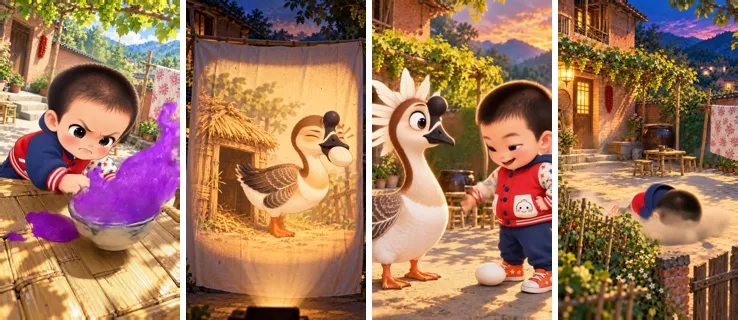
- v3 and v4The new story in six 5-second segments on Kling 4. The dog finds Alice at the door, too easily.
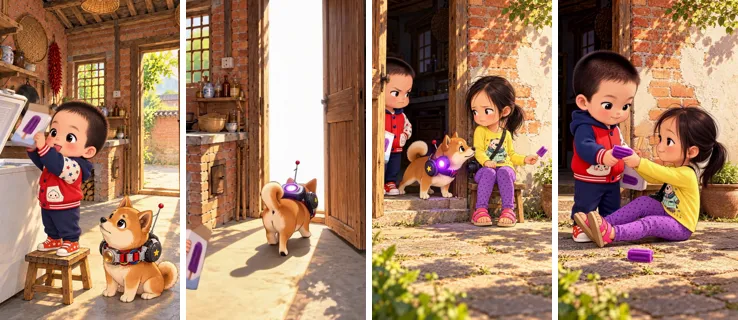
- v5A trail of drips to the water vat, and a grab on her leggings for the fall. 28 seconds, with almost no chase.
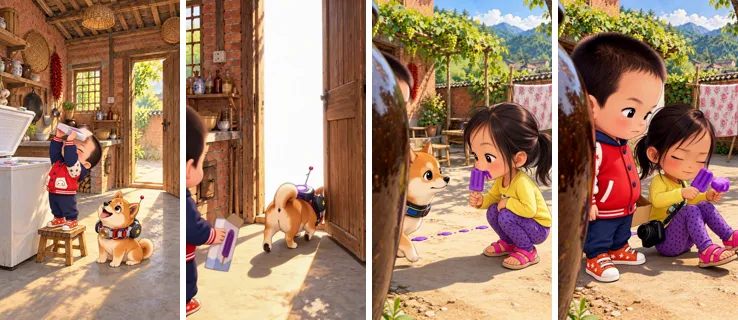
- v6 to v9Two chase rounds added, the eating shot retaken, Xiaobai's stare trimmed. 36 seconds.
What it cost
About $16 of video generation, three times Episode 2. A quarter of it went on the version we threw away, and most of the rest on retakes that a better script would not have needed.
| Step | What we generated | Generation cost |
|---|---|---|
| Version 1, thrown away | 17 clips of 3 seconds on Kling 3.0 Omni | ≈ $4.30 |
| The new story | 7 clips of 5 seconds on Kling 4 | ≈ $5.50 |
| Search and fall rewritten | 5 clips of 5 seconds | ≈ $3.90 |
| Chase rounds and the last piece | 3 clips of 5 seconds | ≈ $2.40 |
What we check before the next episode
- 1Tell the story in one sentence, and give every beat a reason the viewer can see.
- 2A second reader looks for holes in the script before any picture is drawn.
- 3One beat per segment; a key object gets a count ("exactly ONE popsicle").
- 4A character who must stay in the scene is told to stay in frame.
- 5A fight or chase gets at least three rounds, each one its own segment.
- 6Follow every object frame by frame: where it comes from and where it goes.
Questions
- How do you keep AI video continuity between shots?
- Start each clip on the last frame of the clip before it, and only draw a new first frame where the scene really cuts. In Episode 3 only two of eight segments have a drawn first frame; the others carry positions, props and light straight across.
- Why use 5-second segments instead of 3-second shots?
- Five seconds holds one whole beat without cutting away in the middle, and fewer cuts mean fewer places for the scene to jump. It does not hold two beats: every segment where we asked for two had one of them come out wrong.
- Can I reuse this Kling AI animation prompt for my own characters?
- Yes. Save your characters once in RefVid from a few pictures, use the previous clip's last frame as the first frame, write the action as numbered visible steps, and keep the closing line "Keep the drawn style." for a drawn look.