Composed first frames for user-framed product turntable videos on a commercial video model: an exploratory case study
- Author
- RefVid
- Published
- Zenodo DOI
- 10.5281/zenodo.24288649
Status: exploratory engineering case study; no controlled evaluation has been run (Section 11 describes the planned one).
Abstract
We describe a browser-based product-framing interface that combines normalized footprint layout, reference-photo cut-outs, first-frame conditioning of a commercial video model (Kling 4 reference-to-video, accessed through fal.ai), and deterministic endpoint holds. The task came from a European furniture manufacturer with a catalogue of about 2,000 products, who wanted 360° turntable videos generated from three or four ordinary product photos and named three defects that blocked adoption: no control over the product's size and position on the platform, parts of the product passing over the platform edge during the turn, and a visible jump where the loop restarts. The interface lets the user set four layout parameters, previews the composition, rasterizes it (without UI guides) as the clip's start image, and after generation appends still frames before and after the turn in the browser. Text-only control, numeric layout instructions and start-and-end anchors on an earlier model were tried first (Section 3). In exploratory, unblinded tests the output first frame approximately followed the composed product and platform layout in 6 of 7 Kling 4 clips (all 6 with a photographically shaded turntable, 0 of 1 with a flat drawn disc); this is layout adherence, not whole-frame adherence: in the four production clips the drawn backdrop was retained in 3 of 4, and the model replaced it in the armchair clip. In those four clips with deliberately different settings no product part was seen over the platform edge in the sampled frames and the reported first/last-frame difference was low. These observations are encouraging but small, adaptive, partly not independently reproducible, and do not establish a success rate, physical scale across products, containment throughout the turn, or seamless looping. The size control normalizes each product's footprint to the platform; it does not impose a common physical scale. The customer then commented on the four clips (background, platform thickness and position, and a round shadow under the corner sofa); frame 0 was revised with a fitted studio backdrop and the product's own floor shadow lifted from its white-background photo in place of a drawn ellipse (Section 5). Six later clips with the fitted grey backdrop and fixed settings (Section 7.6) added one further observation: with the start image only, the camera pushed in steadily through one bed clip until the plate left the frame, while four other pieces kept the composed framing in every frame sampled every 0.5 s (operator's measurements); a repeat of the bed with the same composed frame also sent as the end image kept the framing and turned a full circle. The start-only take drifted and the start-and-end-conditioned take did not; the intervention's effect and the source of the variation remain unknown. Sending the composed frame as the end image was nevertheless built and deployed the same evening (Section 4.4): on Rotation Auto or 360° it is now sent automatically. That is an engineering decision, not a demonstration of the effect. A second, approximately matched pair made afterwards, on a green armchair at 720p with otherwise identical settings and the end image added by the automatic path, showed the same difference: the take presumed to carry the start image only (its missing end image is inferred from timing and page state, not read from the request) pushed in until the plate left the frame, the start-and-end take kept the framing and turned a full circle. Two pairs of one take per arm do not establish the effect. Two clips, one with and one without the end image, reached the front pose 1–1.5 s early and then stood almost still, lengthening the visible pause; of the two start = end clips one reached the early-arrival threshold and one did not, so its relation to the end image remains uncertain. Five of the six clips were sent to the customer, whose verdict has not been received. The shading variants of Section 5 have not been compared.
1. Introduction
1.1 Problem and customer need
Input: three or four catalogue photos of one product on a white background (front first), and a product type (sofa, armchair, corner sofa, pouf, bed, other). Output: a short video of the product turning once on a round studio turntable, with a fixed camera, in 1:1, 9:16 or 16:9.
The customer, a European furniture manufacturer, had made several turntable clips on a self-serve AI video platform and said it would consider using it for a significant part of a collection of about 2,000 products if results were consistent and presentation could be controlled. Their requirements, summarised from the correspondence:
- R1. Size and position control before generation, consistent across the collection. The user previews and adjusts the product's scale and position on the platform, and pieces keep consistent proportions across videos. The customer described sofas too large for the platform with legs over the edges, sofas much too small, and an armchair that looked right alone but out of proportion next to sofas from other videos. The request was repeated in two later rounds of feedback.
- R2. Containment. Every part of the product stays on the platform for the whole turn (raised about a corner sofa whose rear leg passed the edge mid-turn).
- R3. Loop. No visible jump where the turn restarts; optionally a pause of about 2 s after the turn.
- R4. Smooth rotation, without stepping, raised about player-side slow playback (0.5×). Constant angular speed was never requested.
- R5. Rotation range other than 360° (270°, and a swing: from the front 90° to one side, back to the front, then 90° to the other side).
- R6. Per-format composition for 9:16, 16:9 and 1:1 rather than cropping, which the customer judged insufficient for large pieces such as sofas, corner sofas and beds.
This report addresses R1–R3; R5 and R6 enter where they affect the design.
1.2 Why this is hard on a commercial endpoint
The photos reach the model as references, not as a picture of the scene. The model draws the turntable, its size and position, the camera distance and the product's size itself, and each clip is generated independently. The fal schema for Kling 4 reference-to-video [19] lists prompt, multi_prompt, duration, start_image_url, middle_image_urls, end_image_url, image_urls, video_urls, elements, voice_ids, resolution and aspect_ratio; no exposed parameter carries camera pose, rotation direction, physical scale, seed or guidance. Geometric requirements can therefore be expressed only as words or as images. We make no claim about the proprietary model's internal mechanisms.
1.3 Contribution
An engineering integration and exploratory deployment study, not a new video-generation method:
- A browser composer that places the product's own cut-out on a drawn, photographically shaded turntable at four user-set parameters, with the floor shadow taken from the product photo itself (Section 5), previews it, and sends it as the clip's start image (on full turns now also as its end image, Section 4.4) together with the multi-view references and a structured prompt.
- Deterministic browser post-processing that appends still endpoint frames (holds) to the generated clip.
- An account of the failed alternatives (prompt wording, numeric layout text, start-and-end anchors and chained clips on another model, a generated multi-view reference set) and of the reliability limits that remain open.
2. Terms
- Product: one catalogue item (SKU). Shape: the product type chosen in the UI, which carries a generic footprint W × D in cm (Section 4.3).
- Element: the bundle of a product's photos sent to the model as subject references (one frontal image plus reference images).
- Composed frame: the PNG the browser renders from the composer and sends as
start_image_url. Preview: the same composition on screen, with a dashed guide ring that the composed frame omits. - Output first frame: the first decoded frame of the clip the model returns.
- Raw clip: the MP4 as returned by the provider. Held clip: the MP4 after browser post-processing (holds appended, whole clip re-encoded).
- Size: the slider value (30–100%), the product footprint's farthest point from the rotation axis as a percentage of the disc radius. In equations s = size / 100, a fraction.
- Layout adherence: the output first frame shows the product and platform at approximately the composed size and position, judged visually. Backdrop retention: the output first frame keeps the composed backdrop. The two are reported separately; neither is a whole-frame match.
- Prompt v9: the version of the prompt text. Locked recipe: the combination of composed frame, prompt v9 and browser holds adopted after the local tests of Section 3.
- Operator: the team member who generated and measured the later clips; "operator-reported" marks values whose measurement files are not part of the evidence we could re-check.
3. How the method was reached
3.1 Narrative
Starting point. The customer's own first attempts were five clips on three models, made from phone screenshots of a web shop (status bar, address bar and toolbars included, the furniture small in a tall white image; two sets also contained close-up detail shots). Reviewed one frame every 0.5 s, two of the three Kling 4 clips already showed clean full turns; the problems were size on the plate (a sofa as wide as or wider than the plate, an armchair filling the frame as a sofa would, a tiny bed on a large plate), consistency across pieces, a bed that swung to one side only, and in one clip a cut to an armrest close-up with a changing leg count. We attributed the close-up cut to the detail photos; that is a reading of one clip, not a tested cause. Inputs were then prepared by cropping the screenshots to the furniture with about 8% margin and setting detail close-ups aside. On the platform's own template examples, a shoe clip (Kling 3.0 Omni) swung about 75° and back, and a figure clip turned about 270° and cut to a close-up, although the prompt asked for a full 360°. In the inspected clips the camera framing was stable within a clip (plate width 80.9–81.1% of the frame; product top edge moved 1.9%, centre 3.3%), which suggested frame 0 as a control point. A 9:16 centre crop of a 1:1 clip cut up to 28.3% of the product (R6). All clips we measured were 24 fps (Kling 4, Kling 3.0 Omni, PixVerse C1). An initial decision was taken not to build manual size and position control and to rely on prompt defaults instead; it was later reversed.
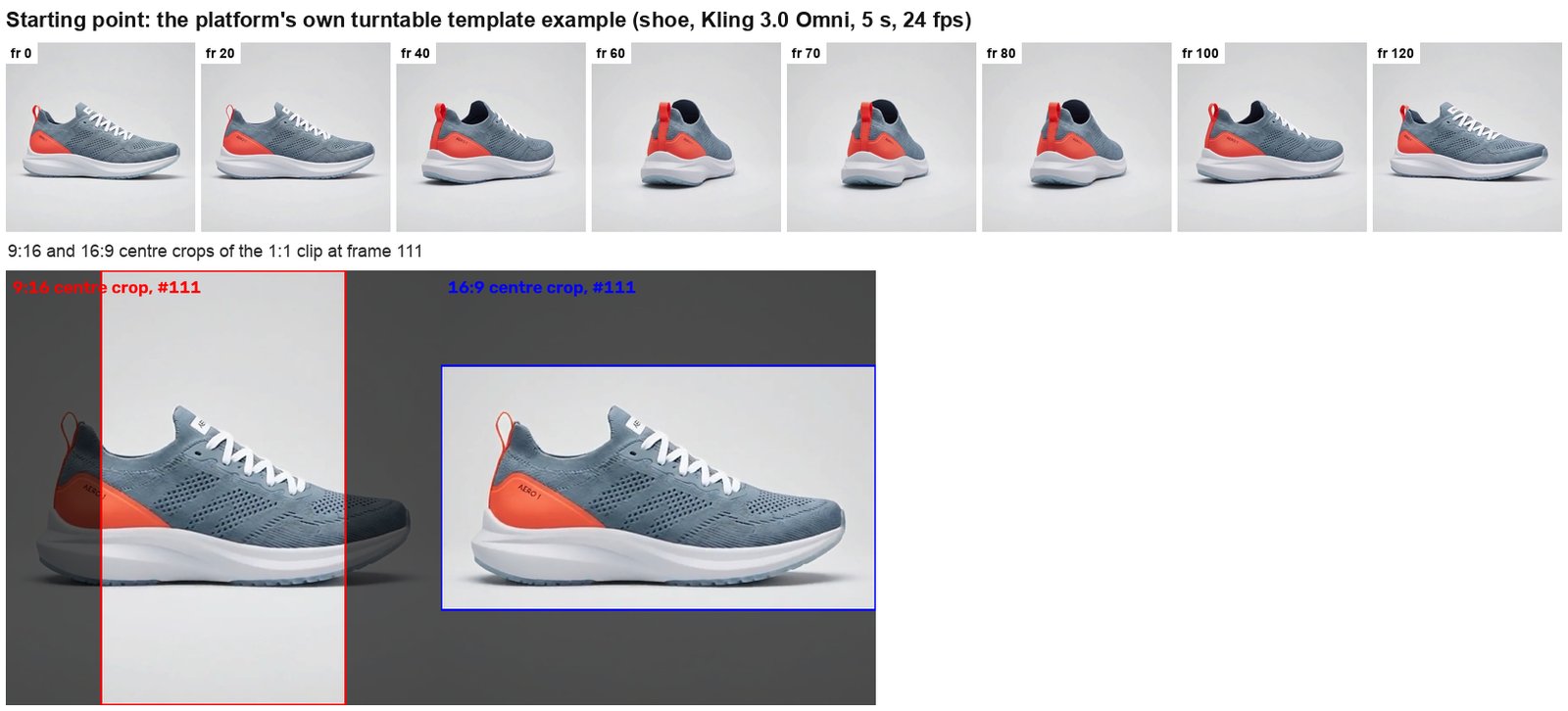
Prompt v1: rotation setting and framing defaults. A Rotation setting and server-composed defaults ("the whole product stands fully on the turntable … centred … fills most of its surface; the camera is locked off") were deployed without a controlled test. "Fills most of its surface" makes every product fill the plate, contradicting the second half of R1. The original proposal for this step had already been to compose the first frame, with a separate option for a shared physical scale (a fixed plate width in cm and each product's real width); the latter was not built.
Smooth slow playback and rotation range by editing (local tests). Frame interpolation (ffmpeg minterpolate) reduced held-out frame error about 4× against plain half speed, with artefacts where parts cross; interpolated output was rejected, and the answer to R4 became a longer clip at the model's native frame rate. For R5, Swing and 270° were cut out of an existing 360° clip without new generation: the turn-back joins were clean (0.90–0.91× a normal frame step), but the join back to the front view jumped 2.28× a normal step and would need a best-matching frame and a 2–3-frame blend; and cutting a range only works on a clip that really turns a continuous 360°, which the model did not guarantee. Rotation range was shipped as a prompt sentence instead, and the moving sequence has remained model-generated since.
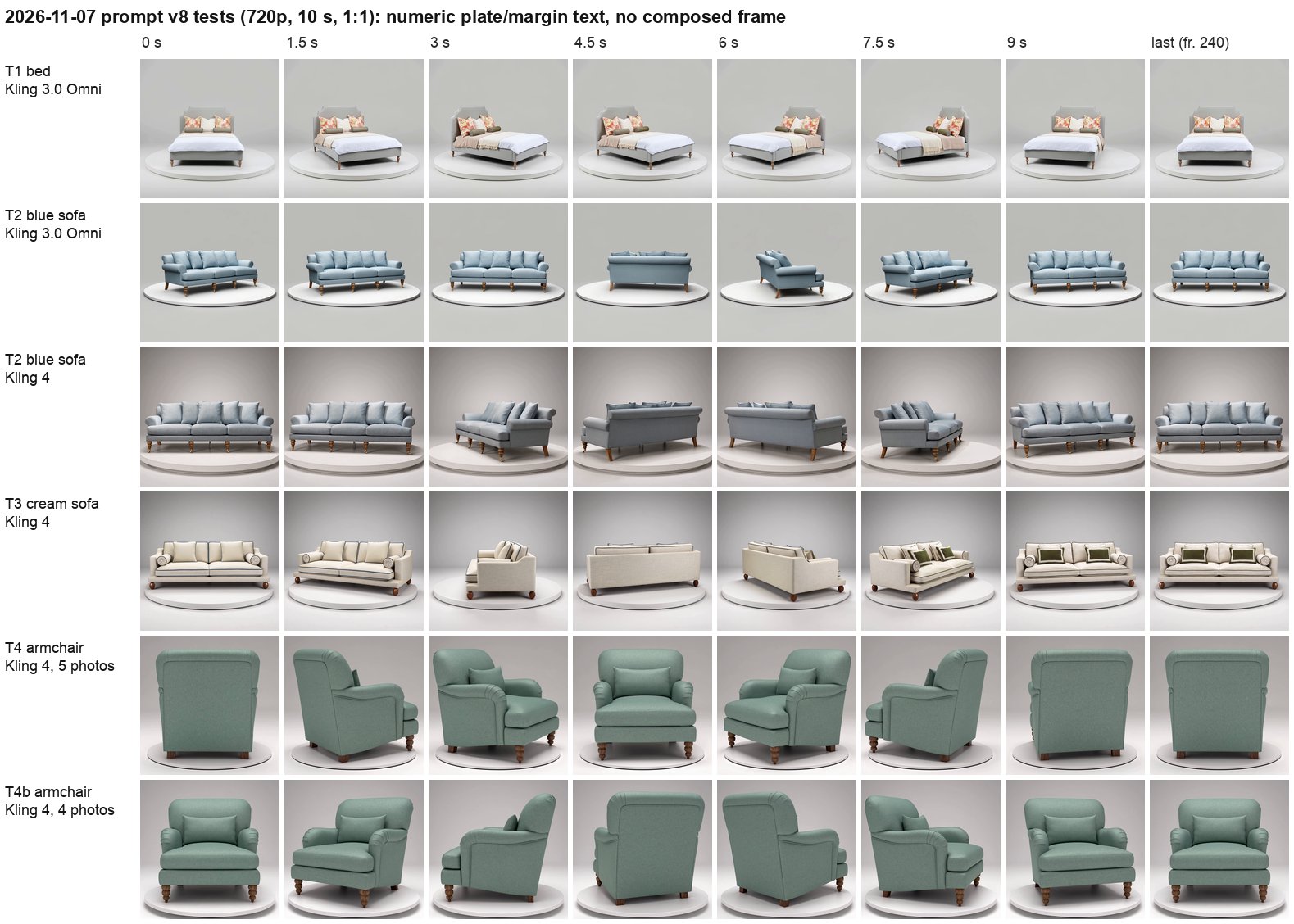
Prompt versions v2–v8. v2–v7 were proposals and drafts, not generated. v8 was tested on production: a bed with Swing (Kling 3.0 Omni), a blue sofa (Kling 3.0 Omni and Kling 4), a cream sofa and a green armchair (Kling 4), 720p, 10 s, 1:1 (Figure 2). Numeric instructions (5% plate gap, 5% frame margins) were not followed by either model; Kling 3.0 Omni drew a large plate and Kling 4 a plate wider than the frame. The same "first reference orientation as 0°" sentence was followed on the blue sofa (Kling 4) and not on the armchair, which started on the chair's back. The cream sofa's six reference photos showed two configurations of the same sofa, and the video switched configuration mid-turn; inconsistent references are a plausible contributor to such changes. A follow-up armchair take (T4b) with the photos reduced from five to four (front, side, back-side, back), all placed in the element with the front as the frontal image, started on the front and made a full, continuous turn back to the front. The tentative explanation recorded at the time was that in the earlier take the fifth (back) photo had been routed as a separate reference image rather than into the element. One pair of clips; not conclusive, but it suggests that reference routing, not only sentence compliance, affected the starting pose.
The customer's collection. The customer then sent five pieces (armchair 85 × 85 × 82, sofa 240 × 94 × 82, pouf 105 × 60 × 47, corner sofa 240 × 200 × 82, bed 210 × 163 × 123 cm) with 3–4 photos each, 16 in all, and a dimension sheet. All are cut-outs on white at about 1200 × 800 px; the pouf photos are 3D renders, with the pouf filling only about 45% of its frame; armchair, sofa and bed have no straight back view (armchair and sofa have a rear three-quarter view; the bed has no view of the headboard's back); the corner sofa photos have a faint grey vignette instead of pure white and show the chaise on the right in every view; the bed's bedding is styled differently between photos. "Ordinary product photos" in this report means these catalogue images, and fidelity claims are limited to what they show. The generic footprints of five of the six shapes in Section 4.3 (all except "other") are these pieces' dimensions.
Hidden prompt layers. The products were generated on production (Kling 4, 1080p, 1:1, 10 s) while editing server-side prompt layers: v1 "never reverse"; v2 removed "axis" and added a flat-disc sentence after a take with a white pole under the seat; v3 "frame 1 shows the product at exactly 0°"; v4 a new Swing sentence. With v3, armchair, sofa, pouf and corner sofa started on the front and made one turn with no pole. The bed failed twice, and its photos disagreed. The customer had been told shortly before that manual sizing was not recommended. Four of these clips were delivered and form the baseline of Section 7.2; the customer's reply raised scale, the end jump and the corner sofa over the edge.
Mechanism analysis, an over-promise and its correction. A reply to that feedback promised a matching last frame, a pause, a resized turntable and new versions. On review, none of these was guaranteed by an available mechanism, and a correction was sent stating that exact proportions between products, containment for the whole turn and a last frame identical to the first could not be guaranteed. Two working rules were set: meet a failing requirement by finding a mechanism rather than more trial takes, and judge results only against the customer's own words. The analysis framed two routes: render from a 3D model (Route A), or constrain the video with composed images (Route B). An internal assessment, with its own confidence labels, concluded that text cannot guarantee scale, containment or an exact loop (high); a composed first frame can fix frame 0 (high); scale after frame 0 is model behaviour (medium, unverified); exact holds need post-processing. The customer asked to keep testing and asked again for user-adjustable size and a 2 s pause. Our reply committed to both: an option to set how much of the frame the product fills, so each product starts at a consistent size, with the caveat that the size may still shift during the turn and the claim that regenerating would usually produce a better result; and a 2 s pause after the full turn. These were commitments in correspondence, not validated technical conclusions; in particular the claim about regeneration was not supported by any measured rate.
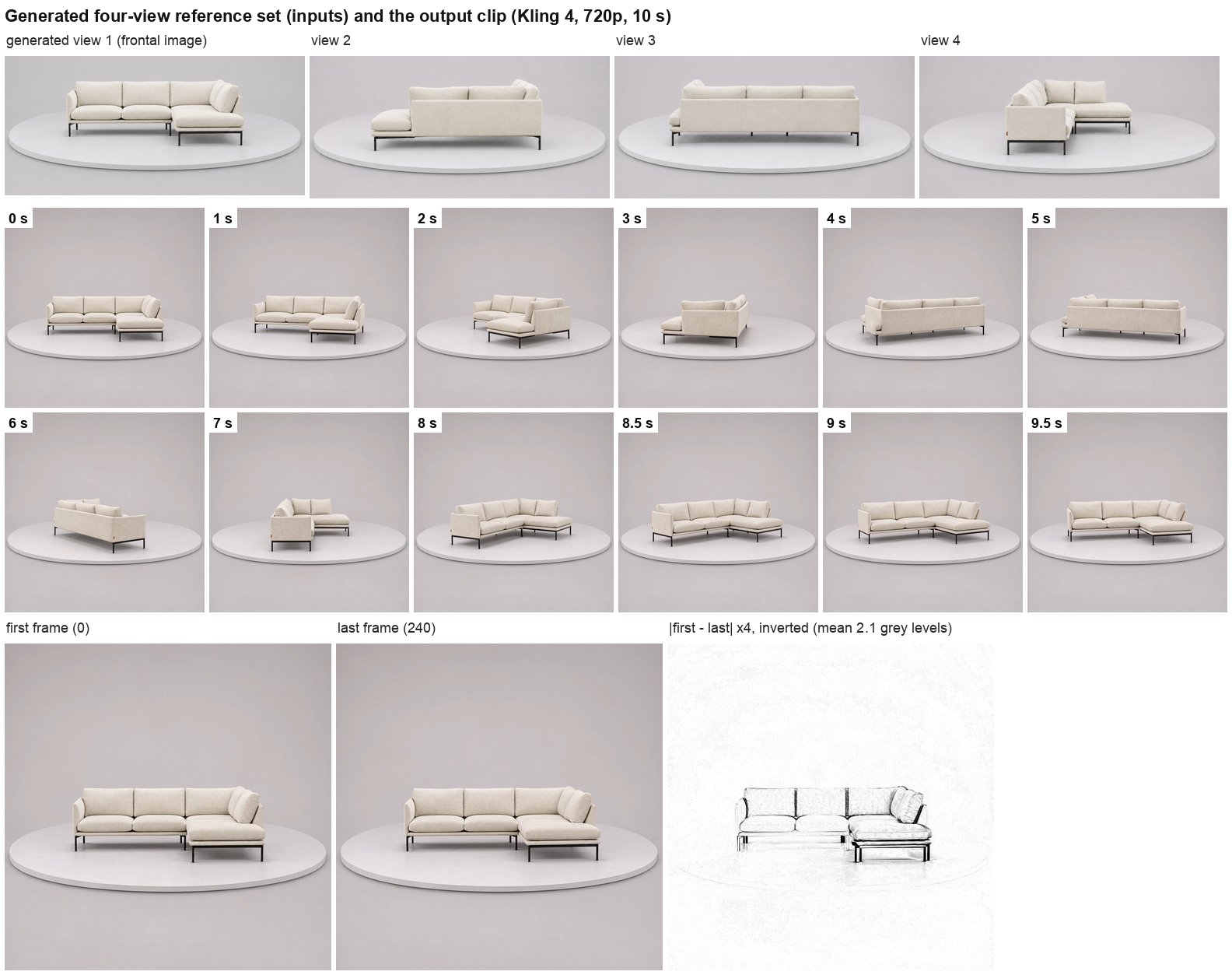
Generated four-view reference set. A production generation on Kling 4 reference-to-video (720p, 10 s, 1:1) used four generated multi-angle images of the corner sofa as one subject reference set (the first as the frontal image, the others as reference images), with no start, end or middle frames. The original request body was not available; the reconstruction is from the stored record and current code. The stored prompt already asked for 90° per quarter, constant speed, no reversal, unchanged structure and a return to the front, and also said "the spin never stops" and "zero dwell", which conflicts with the requested pause. Around 8 s the joint between the long seat and the chaise showed a visible kink that straightened toward the front view, i.e. structural drift (not an angle measurement); first and last frames were both near the front, but the chaise's outer edge and the front legs did not coincide (whole-frame mean absolute grey difference 2.1), so it is not a verified seamless loop; no leg was seen over the plate edge in the sampled frames. The four input views had not been checked for geometric consistency, so input inconsistency and model drift cannot be separated. Separately, four keyframe images generated with an image model showed proportion and detail differences between angles and were not submitted to a video model.
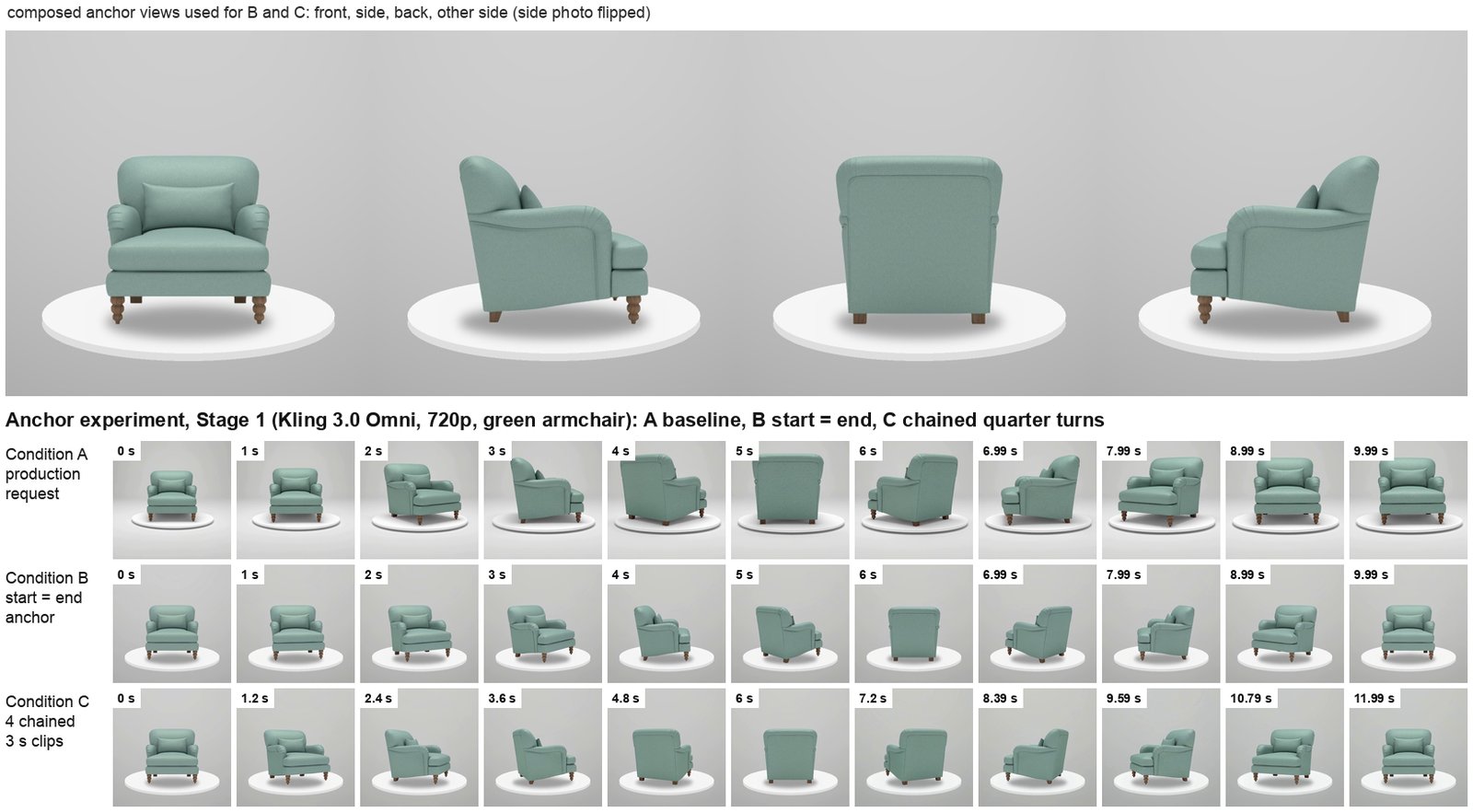
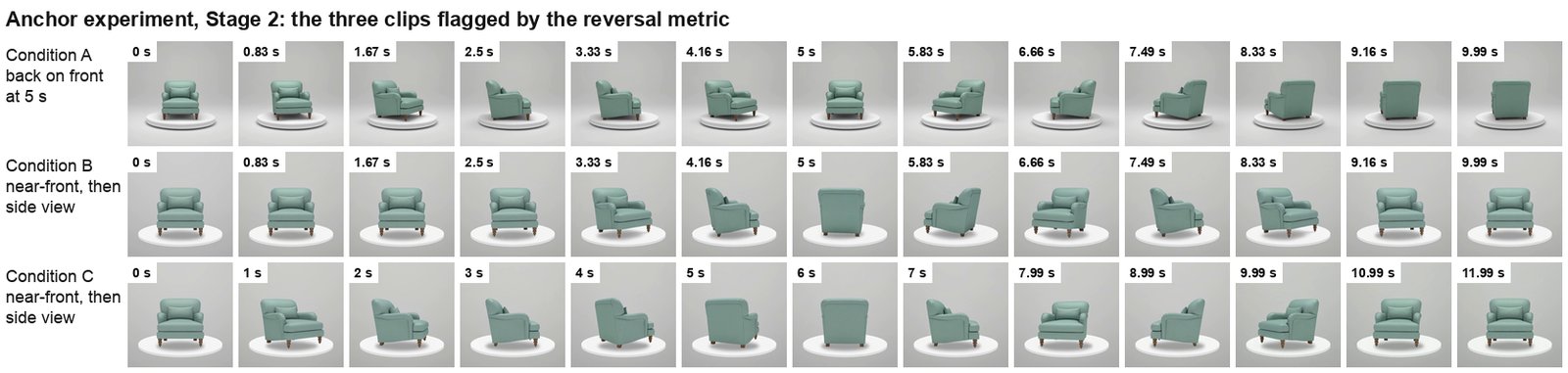
Composed anchors and chained quarter turns on Kling 3.0 Omni. On a green armchair with five consistent photos (Kling 3.0 Omni, 720p, silent, 1:1), three conditions with three clips each: A, the production request (baseline); B, A plus a composed front frame as both start_image_url and end_image_url; C, four chained 3 s clips, each starting on the previous clip's last frame and ending on a composed view of the next side (the 270° view was the side photo flipped). Before any new clip, nine existing clips (mixed models, prompts and products) were scored: 8 of 9 turned all the way round, only 3 of 9 joined within 2× a normal frame step (seam ratios on a centre crop), and only T4b met turn, front start, seam and no change together. The scorer was calibrated on T4 and T4b: an even-turn measure separated T4b's even turn (largest gap 0.36 s) from T4's back-started one (1.38 s); whole-frame seam ratios were 0.49 and 0.88, lower than the centre-crop values of the earlier analysis for the same clips (1.0 and 1.5), so the two measurements are not interchangeable; and Kling 4 drew the armchair at about 73–75% of the frame width against 45% for its real size on a 150 cm plate. Nine final videos came from 18 provider calls (A 3, B 3, C 12), 96 generated seconds. Pass lines were written before the first stage; an absolute seam threshold and a reversal metric were added later (Section 7.4). Results: product width in frame 0 within 0.7% of the composed value in all six B and C clips, while A varied −21% to +18% and one A clip grew 44% during the turn; last against first frame 1.9–2.1 grey levels for B and 3.5–4.5 for C, against 7.2–21.8 for A; no leg over the edge in 16 frames by eye in all nine; one in three clips of each condition reversed or overshot (in the strips, views repeat out of order: one baseline clip is back on the front at 5 s and ends on its back; one B clip and one C clip show a near-front view followed by a side view before ending on the front). Work on this model was stopped; a proposed third stage (direction named in each segment) was not run. Making the video "not model-generated", by pasting the product onto a plate in every frame or replacing frames, was ruled out.
3D route (designed, not run). Sources considered were the customer's own 3D models, or image-to-3D generation from the photos with a small demo budget. A request for 3D files was drafted and not sent. Reasons recorded for not running it: renders would not match the real fabrics, photo-generated models carry guessed geometry and baked lighting, and it is a different product line.
Numeric layout line only, Kling 4. A prompt-only route was tried first to avoid the cut-out cost: a Layout line with the four settings as numbers. In one production take the numbers were not followed. A server-side ffmpeg compose step meant to append holds dropped the still frames; holds moved to the browser.
Prompt v9. v9 merged a labelled-line draft (Scene, Layout, Rotation, Camera, Motion, Product; layout always sent; constant speed; final frame equal to frame 1; rigid product) with the server-side layer v4 that had been live on production (frame 1 at 0° front-facing, rigid spin about the disc's centre, never reverse, quarter timing with the rear view at the half, Swing never showing the rear, flat disc with nothing rising from it, disc level and in place). A saved v4 layer on production would override v9's rotation and motion sentences, so an empty layer version had to be saved right after deployment. Whether and when that reset was done is not recorded. Until it is established, which rotation and motion sentences each later production generation (Sections 7.3 and 7.6) actually received is uncertain; the text in Appendix A is v9 as the code builds it, not a record of what was sent.
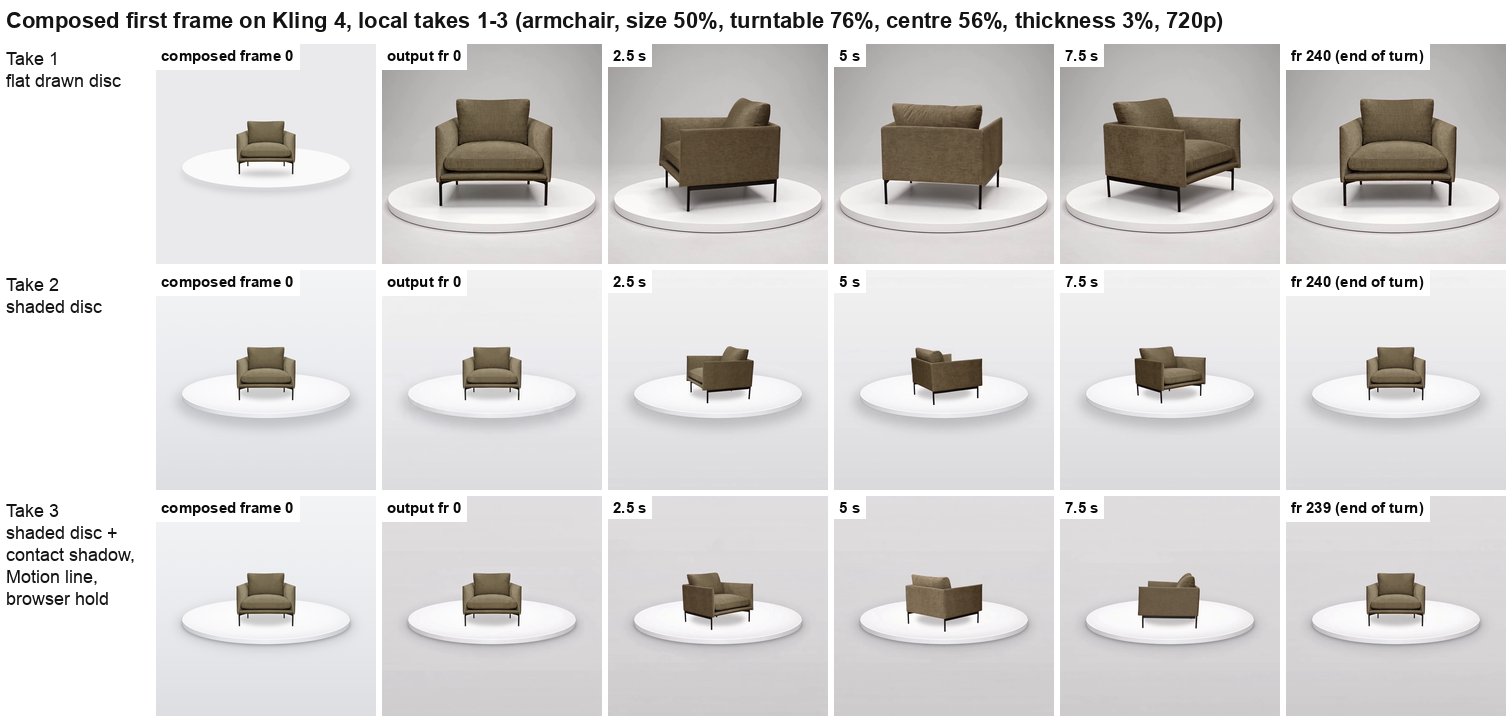
Composed first frame on Kling 4 (local, three takes). On a local deployment calling the real APIs, with an element from the customer's three armchair photos (front first), Kling 4 reference-to-video 720p, 10 s, 1:1, size 50%, turntable 76%, centre 56%, thickness 3%, clockwise:
- Take 1 (flat drawn ellipse and shadow). The provider's request log showed the image received as
start_image_urlnext toelements; the output first frame was the model's own composition (a large chair on a large disc). The turn itself was complete. - Take 2 (single visual intervention: disc redrawn as a studio photograph, with shaded edge, lit top, darkening backdrop and footprint shading; same endpoint, prompt and settings). The output started on the composed frame and the armchair kept its size through the turn and ended on the front.
- Take 3 (bundled revision, three changes together: a tight contact shadow, a new Motion prompt line asking for constant speed from frame 1, and holds made in the browser). Started on the composed frame, size kept, rear at 5 s, front at the end, first/last SSIM 0.98; held file 12.12 s (container duration) with the last 2 s still. Take 3's result cannot be attributed to any one of its three changes.
Take 3 was adopted as the locked recipe, and turn-speed evenness was dropped as a goal since the customer had not asked for it.
Release, production clips and feedback. A walkthrough review before release led to Custom framing tied to Kling 4, per-product shape memory, the cut-out button on the stage, cost lines naming the cut-out, a length label showing the pause, a notice while holds are added, and clearer labels; named presets and a batch queue were deferred. One production clip asked for counter-clockwise and turned clockwise, so direction was hidden. A held clip stopped playing when it replaced the raw clip in the same player; this was fixed. The details page gained an overlay of the clip's actual composed frame, replacing an earlier schematic line drawing. Four production clips with the composed frame (Section 7.3) and a studio tutorial were sent to the customer. The customer's reply gave limited positive feedback on specific points (by our summary: the result close to what they want, the plate diameter right, the 2 s pause working) alongside four corrections: the corner sofa's shadow was round rather than following its shape; the same thin platform should be used in every video; the product should be at the same screen position in every video; and the background of the armchair clip should be used across the collection. They also sent photos of a second bed model and asked for its video. This is not acceptance, and it does not concern the later clips.
Frame-0 shading and the redo clips. The same afternoon frame 0 was revised (Section 5): a selectable studio backdrop fitted to the armchair clip, removal of the drawn ellipse, and a floor shadow lifted from the photo. Six redo clips followed with fixed settings and the fitted backdrop (Section 7.6). The plan had specified four new clips (the second bed, corner sofa, sofa and pouf), with no armchair redo, one take each; six were made: the four planned, an armchair and a second bed take. The bed repeat followed from the drift of the first bed take and changed one condition (the end image); the reason for redoing the armchair is not recorded. The drifting bed take was generated but not delivered, so selection among takes added cost. After the bed pair, sending the composed frame as the end image on full turns was built and deployed (Section 4.4), and five clips were sent to the customer with self-serve steps. Their verdict is pending.
3.2 Chronology
| Date (2026) | Stage | Kind | Outcome |
|---|---|---|---|
| 11-05 to 11-06 | Customer's own five clips; requirements R1–R6; review of clips and input preparation | customer clips, feedback, local review | size and consistency were the main problems; two Kling 4 clips already turned fully |
| 11-06 | Template-clip measurements; interpolation and range-cutting tests; prompt v1 with Rotation setting | local tests, shipped | framing stable within a clip; interpolation rejected; cutting needs a true 360° |
| 11-07 | Prompt v2–v8; v8 tests and the T4b pair | generated (6 clips) | numeric text not followed; reference routing affected the start pose |
| 11-09 | Collection received and inspected; hidden prompt layers v1–v4 | generated | four pieces turned once from the front; bed failed |
| 11-10 | Baseline delivered; customer feedback; mechanism analysis; four-view reference clip | generated, feedback, analysis | scale, end jump, containment raised; structural drift with generated views |
| 11-11 | Anchor experiment on Kling 3.0 Omni | generated (9 videos) | frame-0 size held with anchors; 1 in 3 reversed per condition; stopped |
| 11-12 | Correction of earlier promises; renewed request; numeric Layout line; prompt v9; local takes 1–3; composed first frame shipped | generated, shipped | numbers not followed; shaded composed frame followed, flat one not |
| 11-13 morning | Four production clips; tutorial sent; customer corrections | generated, feedback | layout followed, backdrop 3 of 4; four corrections |
| 11-13 afternoon | Backdrop fit, ellipse removal, lifted shadow | shipped | no generation at that stage |
| 11-13 evening | Six redo clips; automatic end image; five clips sent | generated, shipped | one start-only drift; start = end repeat did not drift; verdict pending |
4. Final method
4.1 Overview
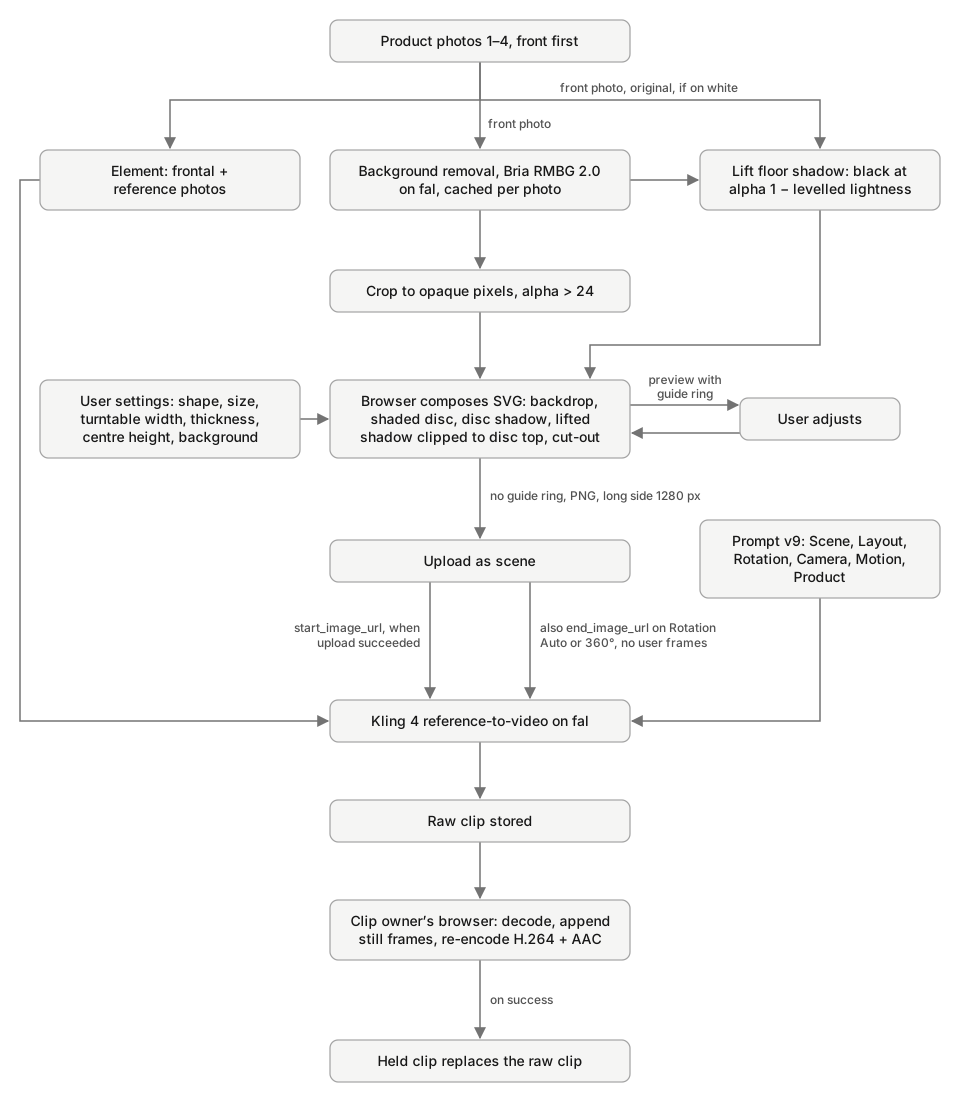
4.2 User flow
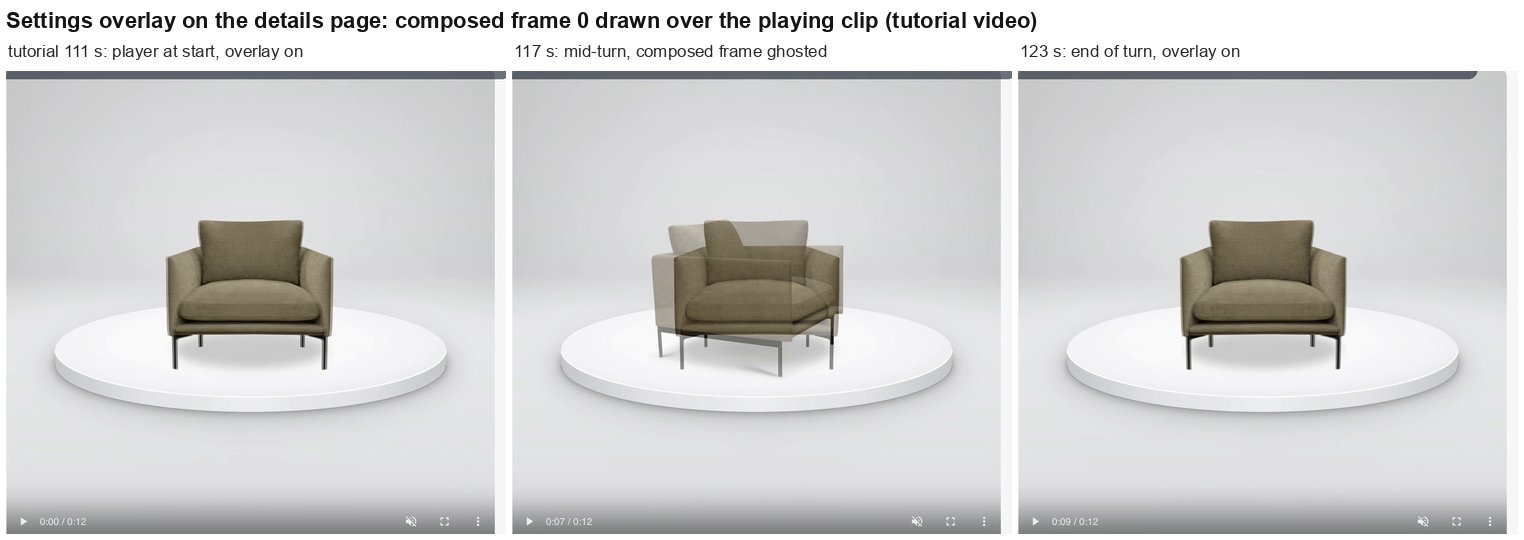
In the turntable template the user ticks Custom framing, which switches the model to Kling 4. The empty stage becomes a live drawing of the turntable with a generic silhouette of the chosen shape. The user runs the cut-out (charged once per photo, refunded on failure, reused afterwards); the cut-out replaces the silhouette. Four sliders with number boxes change the preview live: size on the turntable, turntable width in the frame, turntable thickness, turntable centre height; a Background choice switches between Light and Studio grey (Section 5.1). Rotation and holds are outside Custom framing and cost nothing. If Custom framing is ticked without a cut-out, and the user has supplied neither their own first frame nor a continuation from an earlier clip, generation is refused with a prompt to run the cut-out; with an own first frame or a continuation it proceeds without the composed frame. The studio's photo row always shows a First and a Last frame tile: empty, a tile is an upload button; with Custom framing and a cut-out, the First tile shows the composed frame tagged "Auto first", and on Rotation Auto or 360° the Last tile shows it too, tagged "Auto last". A tap on an auto tile lets the user pick their own picture instead. After generation, the details page lists the settings sent and offers an overlay of the actual composed frame on the video, so the overlay compares the real cut-out with the output (Figure 10). Figures 7, 8 and 10 are taken from a studio tutorial recorded before the Background choice existed.
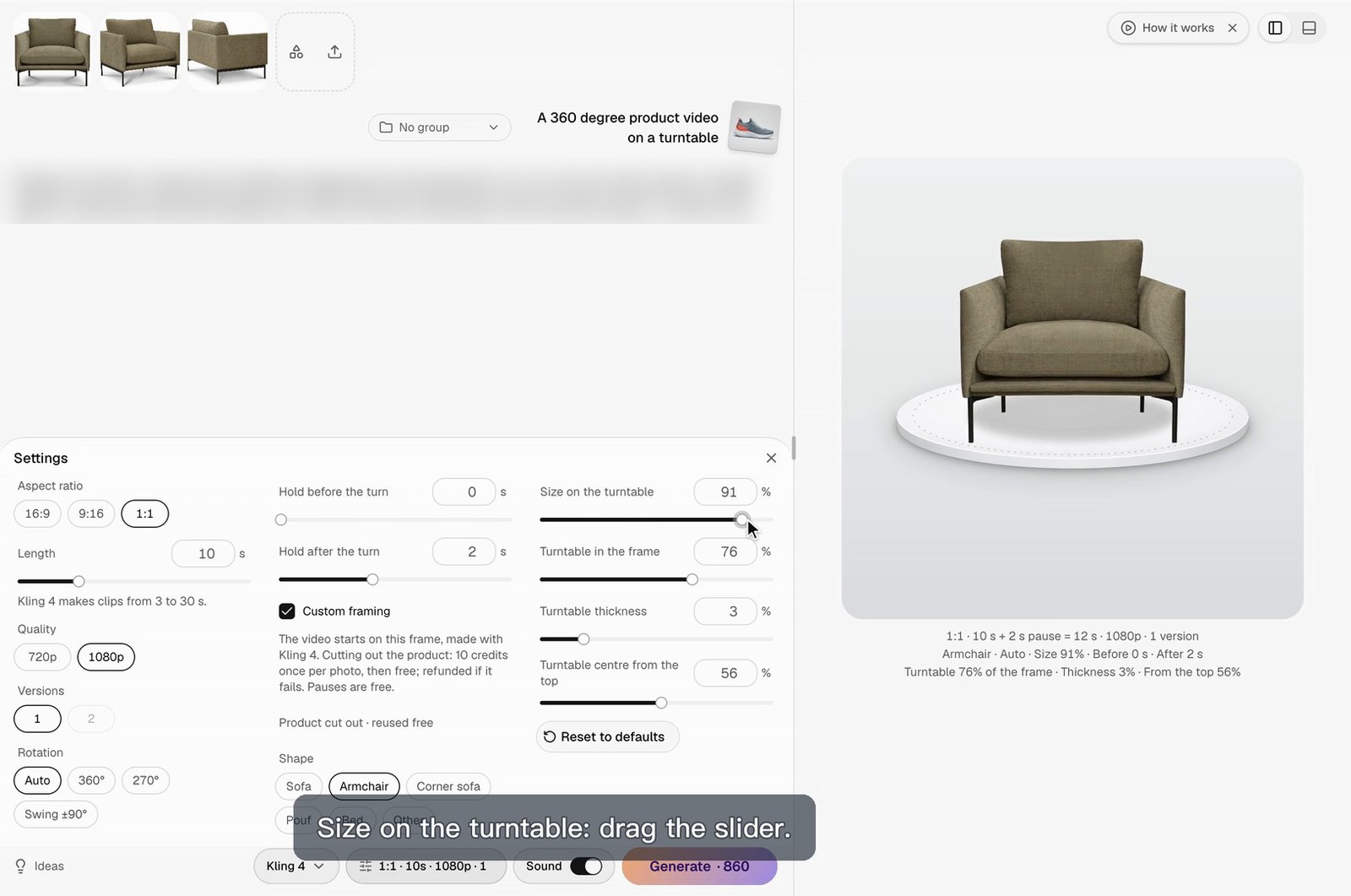
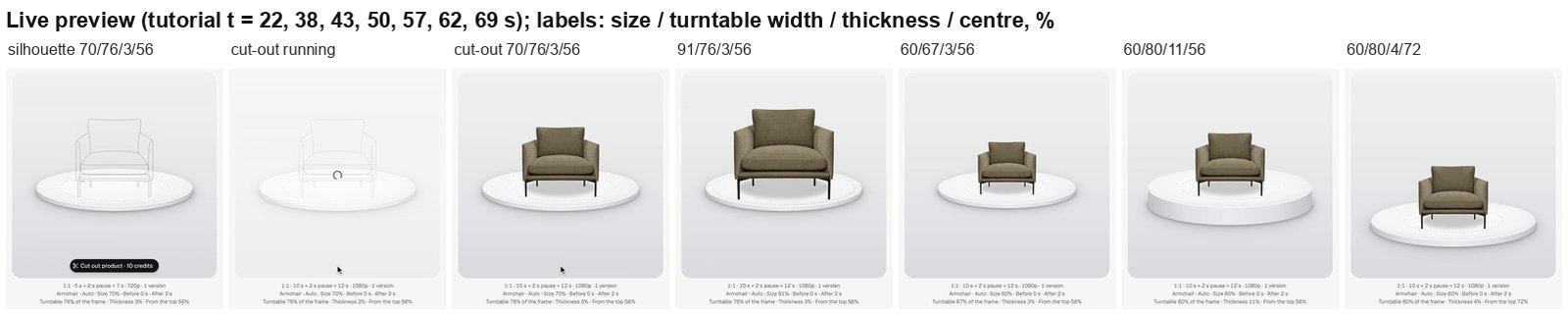

Numeric entry. Until a fix on the morning the production clips were delivered, a number box clamped each keystroke, so typing "60" into Size (30–100) gave 100. The production clips of Section 7.3 were made before the fix; their recorded settings are the values sent, so the defect could have affected what the user intended, not what the record says, and whether any of their values was typed rather than dragged is not recorded.
Settings persist on the account: the turntable parameters are shared by all shapes; size and holds are kept per shape; each product's shape is kept per element.
4.3 Composition
- Stage. Disc centre (300, 400) in SVG units, radius r = 210, viewed 14° from above (tilt = sin 14°, chosen from the model's own turntable clips).
- View. Frame width = 2r × 100 / (turntable width %); height = width / aspect ratio; the disc's top centre sits at the centre-height percentage of the frame. Each aspect ratio gets its own composition (R6).
- Disc. Edge height = thickness % × 2r × cos 14°; shaded edge, lit top with a front highlight, a backdrop (Light: a gradient that darkens toward the floor; Studio grey: Section 5.1) and the disc's own shadow on the floor. Originally a blurred footprint ellipse was also drawn under the product as a contact shadow; it was removed, and the product's floor shadow, when available, is now lifted from its photo (Section 5).
- Product scale. k = r × s / sweep (s as a fraction), with sweep = √((W/2)² + (D/2)²) the distance from the axis to the footprint's farthest corner and W × D the shape's generic footprint (sofa 240 × 94, armchair 85 × 85, corner sofa 240 × 200, pouf 105 × 60, bed 163 × 210, other 100 × 60 cm). The cut-out is drawn W·k wide, centred on the axis, its bottom on the footprint's front edge.
What the scale rule does and does not do. Each shape gets its own pixels-per-centimetre factor k, so the rule controls normalized footprint occupancy: at s = 100% the footprint's farthest corner just reaches the disc edge when it swings past, for every shape. It does not preserve physical scale across products. Doubling both W and D leaves the drawn width unchanged at the same slider value. At equal s, the drawn widths of armchair, pouf and sofa are in the ratio 297 : 365 : 391 SVG units (1 : 1.23 : 1.32), while their real widths are 85 : 105 : 240 cm (1 : 1.24 : 2.82). Cross-product proportions (R1's "consistent proportions") are therefore left to the user's manual choice of s per shape. A true catalogue scale would need a shared physical plate diameter or a common pixels-per-centimetre factor plus each SKU's real dimensions; per-product dimensions alone, fed into the same normalization, would not achieve it.
- Output. The SVG is cloned without the guide ring, serialized, drawn on a canvas with the long side 1,280 px and exported as PNG. The composed frame therefore has the same composition as the preview, excluding UI guides and up to rasterization. It is uploaded and sent as
start_image_url.
4.4 When the composed frame is sent
As start image. It is sent only when Custom framing is on, a cut-out exists, and the user has supplied neither their own first frame nor a continuation from an earlier clip, both of which take precedence. If rendering or upload fails, the error is logged and generation proceeds with no start image. A fail-closed variant is future work.
As end image (added after the paired comparison of Section 7.6; deployed the same evening as reported by the operator). The same uploaded composed frame is also sent as end_image_url when all of these hold: the composed frame is being sent as the start image (conditions above), the user has set no last frame of their own, the model accepts an end image (Kling 4 does), and Rotation is Auto or 360°. It is not sent on 270°, whose end pose differs from the start, or on Swing ±90°, which returns to 0° but has not been tried with it. Shipping it is an engineering decision, not evidence that the end image prevents framing drift. One generation through this automatic path is recorded: an armchair clip (Section 7.6) that held the framing while its start-only twin pushed in. The automated checks are of two kinds: for the user interface, static checks that the eligibility conditions are written as described, which do not render the tile states or execute the upload and request path; for the request builder, unit tests that execute it and check that an end image is forwarded as end_image_url on Kling 4 and both Kling 3.0 Omni tiers and never on models without one. The auto tiles were not seen in a running interface during development because no cut-out could be made in the local environment.
4.5 Parameters
| Setting | Range | Default | Scope |
|---|---|---|---|
| Size on the turntable (footprint farthest point / disc radius) | 30–100% | 70% | per shape |
| Turntable width in the frame | 40–95% | 76% | all shapes |
| Turntable thickness (edge / diameter) | 1–12% | 3% | all shapes |
| Turntable centre from the top | 30–80% | 56% | all shapes |
| Background | Light, Studio grey | Light | all shapes |
| Rotation | Auto, 360°, 270°, Swing ±90° | Auto | per clip |
| Hold before / after the turn | 0–5 s, 0.1 s steps | 0 s / 2 s | per shape |
| Direction | clockwise only | clockwise | — |
Out-of-range values are refused by the server rather than clamped. Counter-clockwise was hidden after Kling 4 ignored it in one production clip; direction exists only as a prompt sentence.
4.6 Prompt
The server builds one labelled line per group: Scene (the user's words), Layout (the four settings in words, only with Custom framing), Rotation, Camera, Motion, Product. Full text in Appendix A. Two implementation details matter:
- Length fallback. If the prompt exceeds a model's limit, candidates are tried with lines dropped in a fixed order: user extra text, Product, Motion, Camera, Rotation, then Layout; the last resort is the Scene line alone. Layout and Rotation are therefore normally but not always sent.
- Default suppression is keyword matching. The Camera and Motion lines, and the Product line's default text, are dropped when the user's own words match topic patterns (e.g. "camera", "zoom", "orbit"); with sound off, the Product line still carries the silence sentence ("The video is silent."). This is not semantic detection of contradiction: it also drops a line on words that agree with it ("keep the camera fixed") and misses some contradicting wording.
The Layout line restates in words what the composed frame shows. In earlier tests numeric layout text alone was not followed (Section 3.1), so the image is the intended carrier of the layout.
4.7 Holds
Holds are not requested from the model. The raw clip is decoded in the browser with WebCodecs; the browser writes copies of the first decoded frame for the hold before, the decoded clip, then copies of the last decoded frame for the hold after; it shifts audio accordingly, fills the holds with silence, re-encodes H.264 + AAC and uploads the result, which replaces the raw clip once. Decoding is used instead of an MP4 edit list because the clips use B-frames and browsers do not honour edit-list dwells. A server-side path through an ffmpeg compose service remains disabled after it dropped the still frames.
Properties and limits:
- Conditional. It runs in the browser of the clip's owner when the clip is shown. If fetching, decoding, encoding or upload fails, the raw clip is left unchanged and the attempt is repeated on a later visit. It depends on browser codec support and device resources.
- Frame-quantized still copies. Each still copy gets one full frame duration and copies are added while their start time is below the requested end, so the repeated samples' nominal durations add up to the requested seconds rounded up to whole frames: 2 s at 24 fps is exactly 48 frames, but 0.1 s gives 3 copies with a nominal extent of 0.125 s. The rest of the timeline does not follow that rounding in the same way. For a leading hold, the moving frames and the audio are shifted by the requested value (0.1 s), not the rounded one, so the last still copy's nominal interval (0.083–0.125 s) overlaps the first moving frame (from 0.1 s). For a trailing hold, the copies start at the end of the last moving frame, but the end used to pad audio with silence is advanced by the requested value. With whole-frame hold values the two coincide; for fractional holds the decoded output's timestamps and A/V alignment have not been measured.
- Not lossless. The whole clip is re-encoded, so neither the moving segment nor the held frames are pixel-identical to the decoded raw clip.
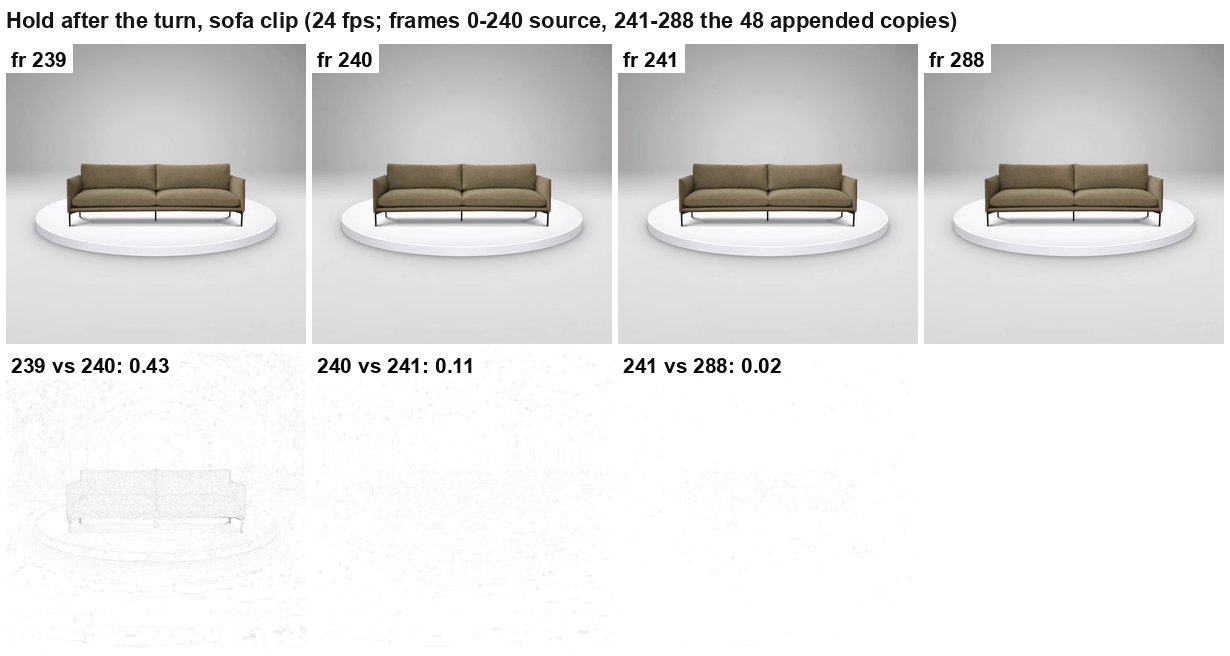
Measured on downloaded held copies of four delivered redo clips (Section 7.6). Each has 289 video frames at 24 fps, a video stream of 12.041667 s and a container duration of 12.120816 s (the AAC audio stream is longer). With a 10 s raw clip of 241 frames, as downloaded 10 s Kling 4 clips have, frames 0–240 are decoded source frames and frames 241–288 are the 48 copies (2 s) starting at 10.041667 s; frame 240 at 10.000 s is the last source sample. The raw files were not kept, so this boundary is inferred from the frame counts and the method, not read from raw media. The encoder places a keyframe every 48 frames (0, 48, …, 240). Greyscale (Rec. 601 luma), full 1440 px: against the first copy (frame 241), every later hold frame differs by a per-frame mean absolute difference of at most 0.010–0.022 grey levels (the range is over the four clips) and a per-pixel maximum of 5–11; against frame 240, the largest per-frame mean is 0.10–0.12 and the per-pixel maximum 12–50 (50 in the corner sofa), because that comparison includes the step from the last source frame to the first re-encoded copy. In the sofa clip the mean absolute grey difference was 0.43 from frame 239 to 240, 0.11 from 240 to 241 and 0.02 from 241 to 288. The hold is therefore visually still but not pixel-identical; the per-pixel residue is encoding noise concentrated at edges.
Untested: fractional holds, holds before the turn, audio synchronization in held clips with sound, and interrupted processing.
4.8 Cost per clip
| Step | Provider list price (read 2026-11-13) | Charged to the user |
|---|---|---|
| Cut-out (Bria RMBG 2.0) [21] | $0.018 per image | a fixed credit charge, refunded on failure, reused |
| Kling 4, 720p [19] | $0.157 / s | standard credit rule |
| Kling 4, 1080p [19] | $0.235 / s | standard credit rule |
| Composition and holds | $0 (browser) | free |
These are provider prices, not retail credit prices, and exclude retries, selection and operator time.
5. Frame-0 shading: backdrop and product shadow
After the customer's feedback on the four production clips, frame 0 was changed in three ways: a selectable studio backdrop, removal of the drawn shadow under the product, and a floor shadow lifted from the product's own photo. All three change only the composed frame; prompt v9 and the request are unchanged. When the changes were made, no generation had used any of them. The six redo clips of Section 7.6 then used the Studio grey backdrop with no drawn ellipse; whether their frame 0 also carried the lifted shadow is not recorded. Their observations are added in Sections 5.1 and 5.7; otherwise this section describes mechanisms and their failure modes, not observed model behaviour.
5.1 Backdrop
All four production clips were sent the same drawn light backdrop (frame-0 pixels 243 / 234 / 221 at top, middle and bottom). The model kept it in the corner sofa, sofa and pouf clips (output first frame 244 / 234 / 222) and replaced it from the first frame in the armchair clip with a darker grey studio (wall about 150 at the corners, about 200 behind the product, floor about 222). The customer then asked for the armchair clip's background across the collection. Because that background was the model's own choice on one take, no setting reproduced it. Custom framing now offers a Background choice, Light (the previous drawing, default) or Studio grey, kept on the account with the turntable settings. Studio grey is a wall radial gradient, a flatter floor radial gradient and a straight blend between them, fitted to the armchair clip's first frame with product and plate excluded; the fit is reported internally as a mean error of 1.7 grey levels (0–255) as rendered in Chrome (1.5 for the fitted model before rendering). The Chrome measurement's protocol (channel conversion, mask, resolution, browser version) was not recorded and it has not been independently reproduced. An independent check on saved 720 px images (reference frame, fitted model, mask and the frame-0 SVG), with the mask thresholded at > 127 (73.4% of pixels kept) and the masked mean absolute grey difference against the reference, gives 1.63 for the fitted model image (already greyscale) and, for the frame-0 SVG rendered at 720 × 720 with librsvg 2.58.4, 1.48 with a Rec. 601 luma conversion or 1.43 with Rec. 709 weights on the encoded values. None of these protocols is canonical, and none confirms or refutes the Chrome figure. The SVG render also contains the guide-free silhouette outline of the preview, part of which lies inside the kept mask. In the masked error map, errors concentrate in the wall-to-floor blend band and the outer wall. The fit is intended to reproduce the requested look in frame 0.
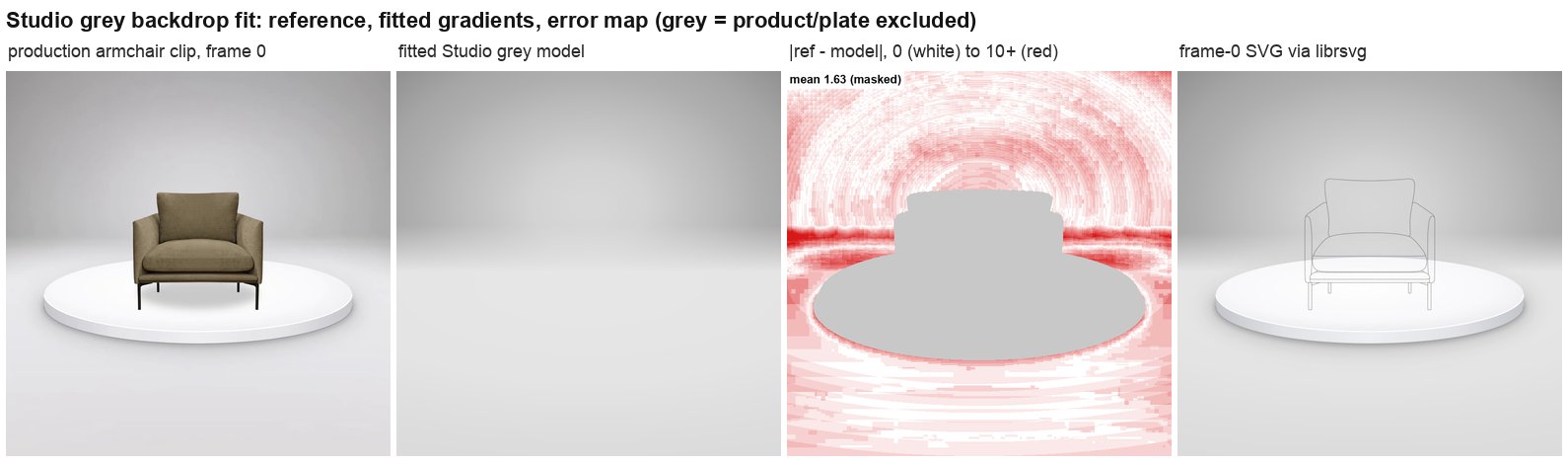
Fitted geometry. Pixels of the armchair clip's frame 0 with product and plate masked were fitted with two radial gradients and a straight blend. Positions are taken from the plate's back edge (y = cy − r · tilt), so the backdrop follows the plate's size and height; at turntable 80% and centre 58% in 1:1 the back edge is at about 48% of the frame height, as in the armchair clip. The wall gradient is centred 0.133 h above the back edge (35% from the top at those settings), with an ellipse parameter of 0.40 w × 0.30 h (the gradient radius is 1.71 times that, so the last stop falls at about the corners) and grey stops 216, 215, 211, 199, 188, 175, 166, 145. The floor gradient is centred 0.067 h below the back edge (55%), 0.80 w × 0.30 h (×1.62), stops 231 → 219. The wall is masked over the floor by a straight vertical blend from 0.063 h above to 0.037 h below the back edge (42% → 52%). Earlier hand-made versions, a guessed vertical gradient and a curved blurred floor line, were judged wrong by eye before the fit was measured (operator's account; those versions were not kept).
Retention, two separate sets. Light backdrop, the four production clips of Section 7.3: retained in 3 of 4 (above). Studio grey, the six redo clips of Section 7.6 (a different backdrop, different settings, a different reference): the operator reports a grey studio in the output of all six. For this report a grey studio was seen in the five downloaded clips that could be tied to a generation by name or by content (sofa, pouf, corner sofa and both bed clips); no downloaded file could be tied to the redo armchair clip, so its retention rests on the operator's report alone. The operator compared output grey levels with the armchair clip the backdrop was fitted to: wall corner 147–150 against 150, wall centre 204–206 against 208, floor 229 against 231 and 220–221 against 220 (which clips each range covers, and the sample points, are reported by the operator; measurement files not available). A spot check for this report on the decoded first frames of the downloaded held copies (top corners and a bottom corner, 4% squares, greyscale) gave top corners 147–149 and bottom corner 218–220 for the sofa, pouf, corner sofa and the start = end bed, against 151–154 and 221 for a downloaded copy presumed but not proven to be the armchair production clip. Retention in the second set is therefore operator-reported in 6 of 6, seen for this report in the 5 attributable downloaded clips, and close numerically at the points measured in 4 of them; the two sets are not pooled, and Light against Studio grey has not been compared under matched conditions (Section 11, ablation 9).
5.2 The product's floor shadow: problem
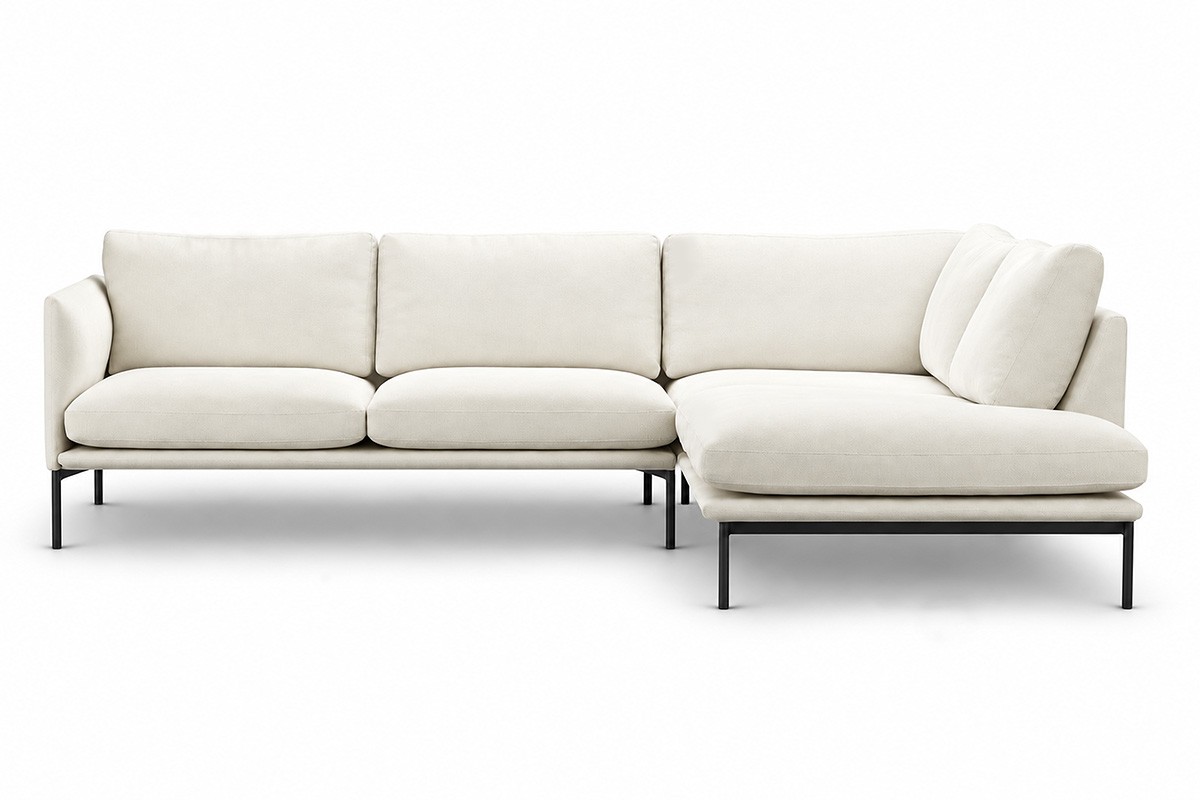
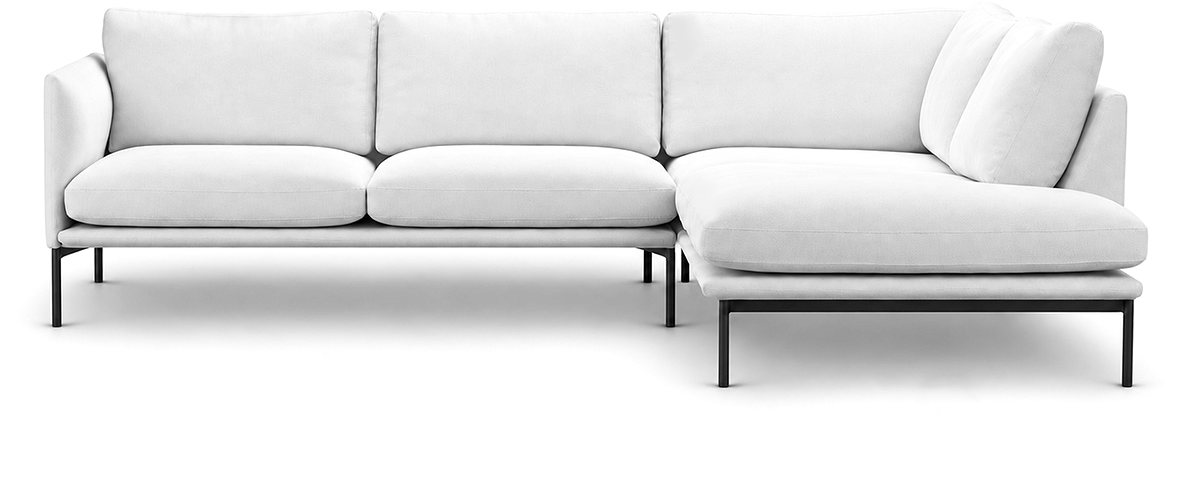
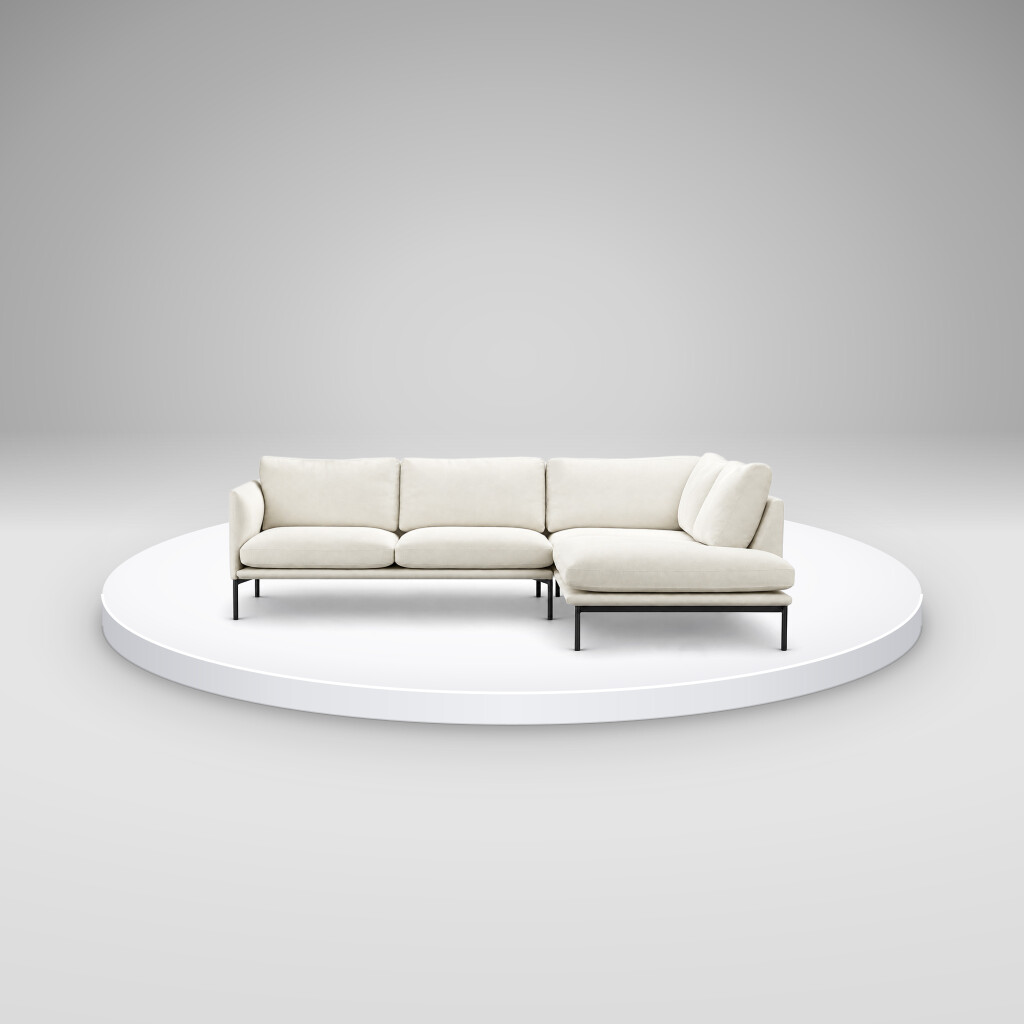
A cut-out removes the background together with the floor shadow that a white-background catalogue photo carries (Figure 15 shows such a shadow under the seat and the chaise). Originally frame 0 compensated with a drawn footprint ellipse: 20% black, blurred, with semi-axes 0.92 × W/2 × k and 0.92 × D/2 × k × tilt from the shape's generic footprint (Section 4.3). On the armchair, sofa and pouf the ellipse lay mostly under the piece. On the corner sofa (generic footprint 240 × 200 cm) it was a filled oval derived from a near-square footprint (in screen space its axis ratio is (200/240) × sin 14° ≈ 0.20, so it is not round on screen), while the product is an L, so much of it lay in the L's empty corner (about half, by our internal description). The customer reported that the shadow was round rather than following the corner sofa's shape, and in the production corner sofa clip a broad grey patch is visible on the plate during the turn (Figure 13).
5.3 Alternatives that did not work
| Alternative | What was tried | Evidence | Outcome |
|---|---|---|---|
| Drawn footprint ellipse | the shipped frame 0 of the four production clips | grey patch on the plate during the corner sofa turn, consistent with persistence of the drawn footprint shadow (Figure 13); customer's complaint | removed |
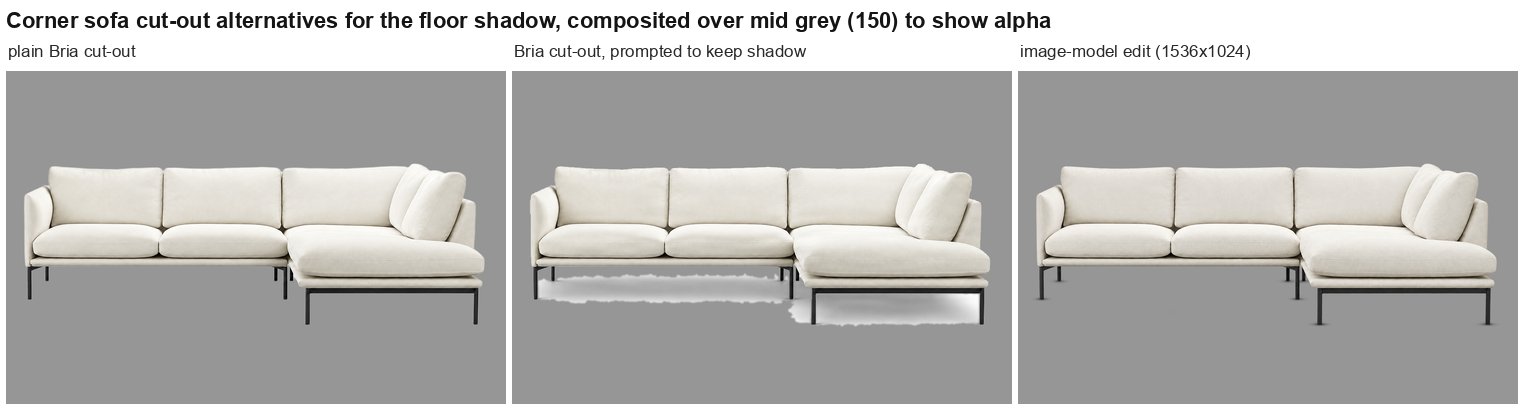
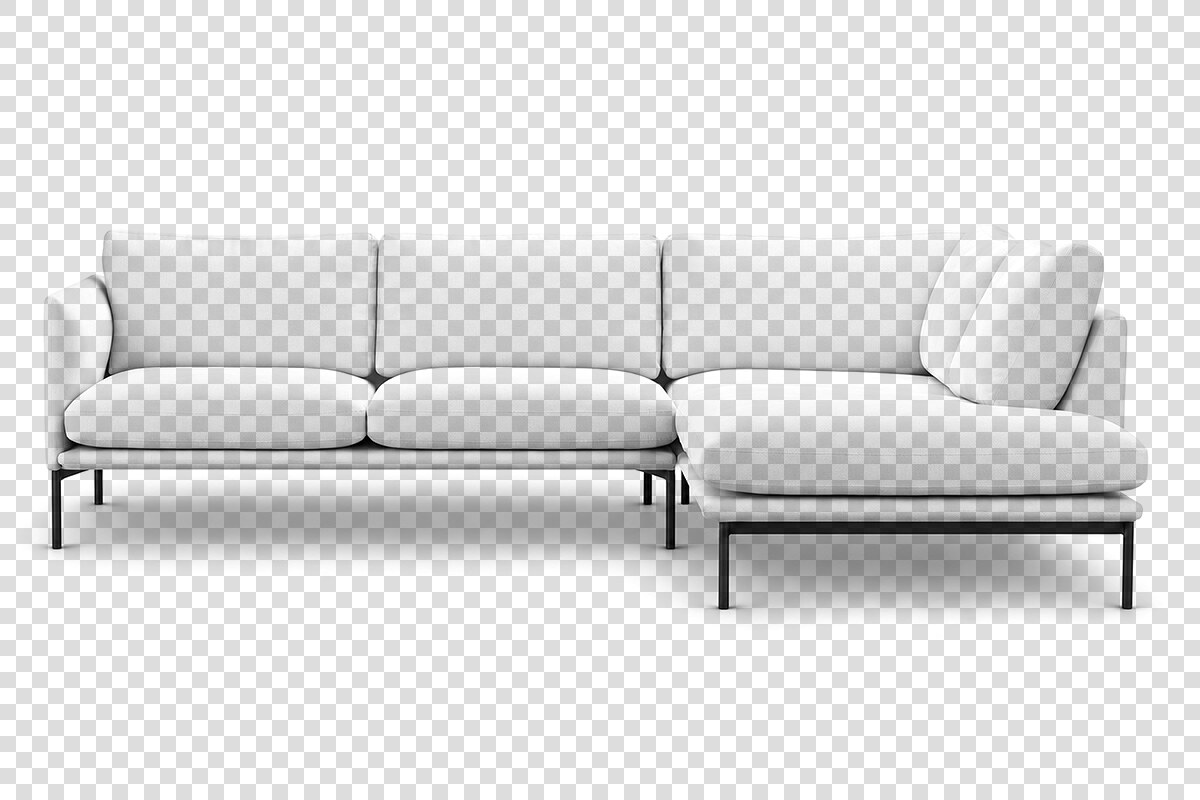
| Cut-out prompted to keep the shadow | Bria cut-out with a prompt asking to keep the shadow (exact wording not recorded), five product photos | the floor under each piece came back as opaque, near-white pixels rather than a semi-transparent shadow (by visual inspection): on the corner sofa the share of near-opaque pixels (alpha ≥ 95%) rose from 29.1% of the canvas for the plain cut-out to 35.6%, while intermediate-alpha pixels (5–95%) were 1.6% (measured for this report on the saved PNGs; these shares alone do not say whether intermediate pixels are floor shadow or segmentation edge) | not used |
| Image-model edit to a transparent PNG with a semi-transparent shadow | the corner sofa photo edited by a general-purpose image-generation model | the shadow was lost apart from small marks under the leg tips (by visual inspection; intermediate-alpha pixels 0.7% of the canvas, against 0.8% for the plain cut-out); the image was regenerated at 1536 × 1024 from a 1200 × 800 photo, so pixel correspondence with the photo, and therefore the product's fidelity, is not guaranteed | not used |
| No product shadow | frame 0 with the ellipse removed and nothing in its place (superseded within the hour) | none: no clip was generated from it. The concern was that with no shadow in frame 0 or in the reference photos the model may not cast one; this is a hypothesis, not tested. In the production clips, where frame 0 had the ellipse hidden under the armchair, sofa and pouf, the model cast a shadow as they turned | superseded |
5.4 Method: the shadow lifted from the photo
The catalogue photos are on white, so outside the product a pixel's darkness approximates the shadow's strength. The method uses that darkness directly. It uses no AI model, costs nothing beyond the cut-out already made, and leaves the cut-out asset itself unchanged (it is drawn over the layer as before).
- Same canvas. The cut-out service returns a cut-out of the photo's full canvas, so the original photo and the cut-out are expected to correspond pixel for pixel. Only equal dimensions are checked; registration is not verified. The browser loads both the original photo and the cut-out, also for cut-outs made earlier.
- Region. The product box is the cut-out's opaque bounding box (alpha > 24, as for cropping). The region is that box widened by 5% of its width on each side and extended below by 25% of its height, clipped to the photo; it starts at the product's top edge.
- Strength. For each pixel in the region, lightness L = 0.2126 R + 0.7152 G + 0.0722 B on the 8-bit sRGB values. The photo is levelled so that L ≥ 250 becomes white: ℓ = min(255, 255 · L / 250). The shadow layer is black with alpha a = 1 − ℓ / 255 (stored as 255 − ℓ, rounded).
- Compositing. In frame 0 the layer is drawn after the disc and before the cut-out, scaled and placed with the cut-out (the same pixels-per-photo-pixel factor), and clipped to the ellipse of the disc's top surface. The cut-out is then drawn over it.
In what sense this is a multiply blend. The equivalence holds for the shadow layer alone, over an opaque plate, under these conditions:
- Transmission. Ignoring quantization, the layer's transmission is q = min(1, L / 250), where L = 0.2126 R′ + 0.7152 G′ + 0.0722 B′ uses the photo's encoded 8-bit sRGB values R′, G′, B′. L is therefore a weighted mean of gamma-encoded values (luma-like), not linear-light luminance.
- Quantized alpha. The stored alpha is A = round(255 · (1 − q)), so the transmission actually applied is q₈ = 1 − A / 255.
- Opaque plate. Black at alpha A / 255 drawn source-over on an opaque plate pixel P gives (1 − A / 255) · P = q₈ · P, before any later sampling and rounding. This is exactly multiplication by a neutral grey image of value 255 · q₈, in the encoded values the compositor works in (default Canvas 2D and SVG compositing in the browser operate on sRGB-encoded values).
- Grey versus colour photo. It equals multiplying the levelled colour photograph onto the plate only where that photograph's three levelled channels all equal the scalar q, for example neutral-grey pixels or pixels clipped to white. For coloured pixels, such as a tinted shadow or the upholstery, it is not an RGB multiply of the photo.
- What it is not. It is not multiplication by the original, unlevelled photo, and it is not a physical linear-light attenuation model. A comparison with another multiply implementation is like for like only with the same working colour space, coverage, clipping and sampling.
The final composite is a different matter. Frame 0 then draws the cut-out over the layer. With cut-out alpha m, straight cut-out colour F and the layer's result q₈ · P underneath, a pixel of frame 0 is C = m · F + (1 − m) · q₈ · P. Where m = 1 the cut-out hides the layer entirely, so fully opaque cut-out pixels are preserved. Where 0 < m < 1 (the cut-out's soft edge) the layer shows through, and it carries whatever the photo has there: the product's own darkness, which the layer includes (Figure 16), any white or background contamination in F, and segmentation errors in m can each produce a lighter or darker fringe. The derivation therefore does not establish an artefact-free product edge. What the method does establish is narrower: it has no exclusion gap around the product (build note below), and on the one inspected image, the corner sofa, the edge appeared acceptable to us by eye. Soft-alpha, coloured-edge and browser-rendered edge checks have not been made (Section 5.5).
Consistency with the approved preview. A rasterization of the studio rendering with the lifted layer and of an earlier multiply preview of the same frame that had been approved internally (both whole frames including the cut-out, both at 1,600 px with librsvg, not Chrome) differed by a mean absolute 0.02 grey levels (RGB mean 0.023 / 255; Rec. 709-weighted grey of the encoded values 0.023 / 255; measured for this report). The preview's construction was not recorded, so this checks consistency with the preview, not the formula; and a whole-frame mean is diluted by the unchanged background, so it says little about the edge. An edge-region metric is listed in Section 11.
Build note. An earlier implementation cut the region 2 px clear of the product's edge and kept only pixels darker than 250; the result was judged jagged at the product edge. The final method has neither cut: every region pixel gets the alpha above, and the cut-out alone defines the product's edge.
5.5 Applicability
The layer is made only when all of the following hold; otherwise frame 0 has no product shadow, as in Section 5.3's last row, and generation proceeds.
- Sampled-border brightness heuristic. The median lightness of pixels sampled along the photo's four borders is at least 240. This is meant to reject room or coloured backgrounds, whose dark pixels are scenery, not shadow, and would be printed onto the plate. It is a heuristic, not verification of a white-background photograph: it measures neither background uniformity nor whether the darkness is a shadow, and it passes, for example, a room shot with a white border or an image whose bright perimeter surrounds dark interior scenery.
- Same size. The photo and the cut-out have the same pixel dimensions. This is the only registration check; equal dimensions do not prove pixel correspondence.
- At least one dark pixel outside the cut-out. At least one region pixel with cut-out alpha ≤ 24 has non-zero layer alpha (levelled lightness below 255). This is not a semantic shadow detector: any such pixel, shadow or not, passes.
- The photo loads. A failed load or decode drops only the shadow, not the cut-out.
Unit tests are synthetic array-level tests on a 40 × 30 image with a binary-alpha cut-out. They cover the alpha value of a grey shadow pixel, that a shadow pixel next to the product gets the same alpha as one further away (no exclusion gap in the layer), the region's lower bound, and the null result for a uniformly non-white background and for a clean white floor. They do not exercise feathered cut-out alpha, coloured edges, browser rendering, dimension mismatch, border false positives, or the widened region's lateral limits, and they do not validate rendered edge quality. The method was checked visually on one product photo, the corner sofa. For that photo, the border median lightness is 254.0, the product box is (43, 222), 1106 × 388 px and the region is x ∈ [0, 1200), y ∈ [222, 707), clipped at both sides of the photo; recomputing the layer from the original JPEG reproduces the layer embedded in the saved frame-0 SVG exactly (mean and maximum alpha difference 0).
5.6 Limitations of the lifted shadow
- Camera geometry. The shadow is the photo's view of it (front, slightly from above), scaled with the cut-out. It is not re-projected to the 14° view of the drawn disc and does not use the shape's footprint, so its depth on the plate is the photo's, not the disc's. This is the same perspective mismatch as the cut-out itself (Section 10).
- Non-shadow darkness. Everything dark in the region that the cut-out removed is kept as darkness: gaps between parts of the product that the cut-out made transparent, a visible floor or horizon line, reflections, marks or retouching residue. The region starts at the product's top edge, so gaps inside the silhouette are included.
- Fixed thresholds. The white point (250) and the background test (240) are constants, not measured per photo. A background between 240 and 250 passes the test but leaves a faint uniform tint over the whole region (L = 245 gives about 2% darkening) with straight edges where the region ends; a shadow lighter than 250 is lost.
- Bounded region. A shadow reaching more than 25% of the product's height below it, or more than 5% of its width beside it, is cut off with a straight edge. Shadow beyond the disc's top ellipse is dropped by the clip.
- One view. Only the front photo's shadow is used; whatever shadow the product has after frame 0 is generated by the model.
- Luminance only. Colour in the photo's shadow is not reproduced (Section 5.4).
5.7 Open question
No generation is recorded to have used the lifted shadow. Two observations from the redo clips (Section 7.6), whose frame 0 had no drawn ellipse:
- Corner sofa without the ellipse. In the redo corner sofa clip (Figure 18, lower row) the shadow on the plate follows the L shape at 0, 2.5, 5 and 7.5 s, and no round mark is seen (operator's frames; consistent with plate crops at 0, 3, 5 and 7.5 s viewed for this report). Compared with the patch in the production corner sofa clip (Figure 13), this is consistent with the drawn ellipse having caused that mark, but it is one clip per condition with other settings also changed (backdrop, size, centre), not a controlled removal test; whether this frame 0 carried a lifted shadow is not recorded.
- Shadows apparently copied from the reference photos (hypothesis). The operator compared the armchair's side and back reference photos with its frame at 2.5 s and found the floor shadow in the clip resembling the photos' own shadows. This is a visual impression on one product; it cannot be shown from the output, and it is recorded as a hypothesis about how the model forms the shadow during the turn, not as a finding.
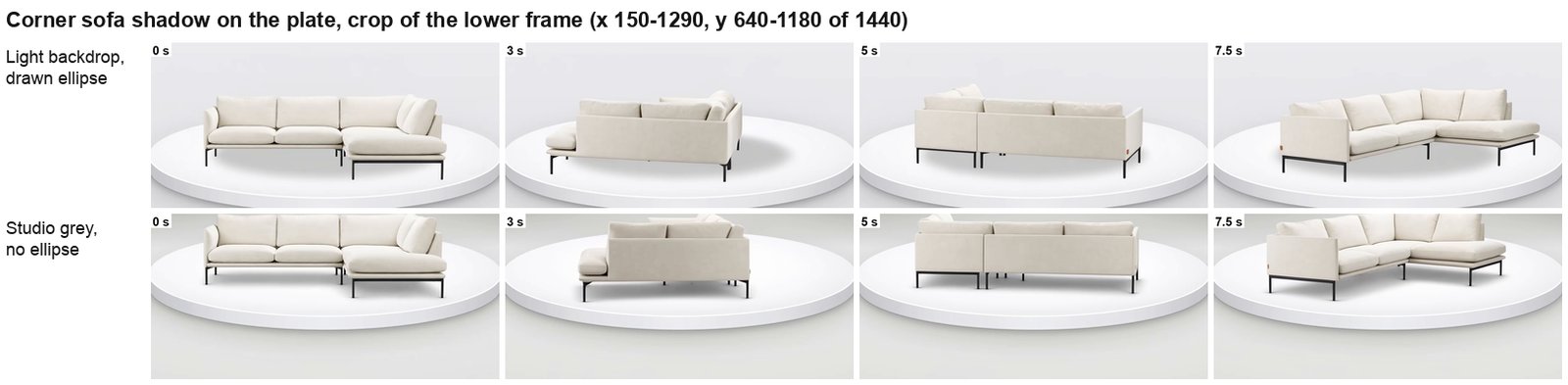
Whether the model keeps a shadow under the product through the turn, turns it rigidly with the product, leaves it as a fixed mark on the plate (as the corner sofa clip suggests it did with the drawn ellipse), or replaces it with its own is unverified. None of these is automatically correct: under fixed lights a real cast shadow changes shape as the object's orientation changes, so neither a fixed mark nor a rigidly rotating copy of the photo's shadow is physically right in general. A second open question is whether a frame-0 shadow changes start-image adherence (Section 7.5). Section 11 lists the ablation for both.
6. What the system determines and what it does not
Determined by the method, under stated conditions:
- On successful rendering and upload, and without a user-supplied first frame or continuation, the composed frame sent as
start_image_urlhas the preview's composition (excluding the guide ring) at the set parameters, in the clip's aspect ratio. - With the same turntable settings, every product's composed frame has the same turntable width, thickness and position. Product size follows the normalized-occupancy rule of Section 4.3, not a common physical scale.
- The composed frame is stored with the generation and can be overlaid on the output.
- Settings are saved on the account and reused.
- When browser processing succeeds, the held clip contains the moving sequence followed (or preceded) by repeated decoded endpoint frames, re-encoded as a whole; for holds of whole frames (such as the 1–3 s used in production at 24 fps) the copies span exactly the requested time, while fractional and leading-hold timing follows Section 4.7 and is unverified.
- The cut-out is charged once per photo and refunded on failure; with Custom framing off nothing of it is sent or charged.
- When all four gates of Section 5.5 pass (sampled-border brightness, equal pixel dimensions, at least one dark pixel outside the cut-out, successful load), frame 0 contains the photo's levelled darkness in the region around the product, clipped to the disc's top, under the cut-out; otherwise frame 0 has no product shadow. Passing the gates does not verify that the photo is a white-background shot, that the darkness is a shadow, or that photo and cut-out are registered.
- When the composed frame is sent as the start image, the rotation is Auto or 360° and the user has set no last frame, the same composed frame is also sent as the end image (Section 4.4). That the model then ends on it, keeps the framing in between, or still makes a full turn is not determined by the method.
Observed in a small exploratory sample, not determined: that the output first frame follows the composed product and platform layout (approximately, by eye); that it keeps the composed backdrop (Light: 3 of 4 production clips; Studio grey, a separate set: operator-reported in 6 of 6 redo clips, seen for this report in the 5 that are tied to a downloaded file, Section 5.1); that the framing of frame 0 is kept for the rest of the clip (it was not in one of the five start-only redo clips, Section 7.6); that the product stays on the platform throughout the turn; loop closure; size and proportions during the turn; a complete one-direction turn; structural fidelity. The moving sequence is model-generated; optional holds repeat decoded endpoint frames, and the complete video is re-encoded. This differs from compositing a product onto a plate throughout the motion, which was excluded by design.
7. Exploratory evaluation
7.1 Status of the evidence
All tests in this report are exploratory: mostly one run per condition or product (the anchor experiment had three runs per condition), settings varied deliberately or adaptively, judged unblinded by the people who built the system, with no held-out products. Metrics were amended during the work (Section 7.4). No result below is a rate, and no comparison between conditions controls for product, parameters or random variation.
7.2 Baseline: delivered clips without a composed frame
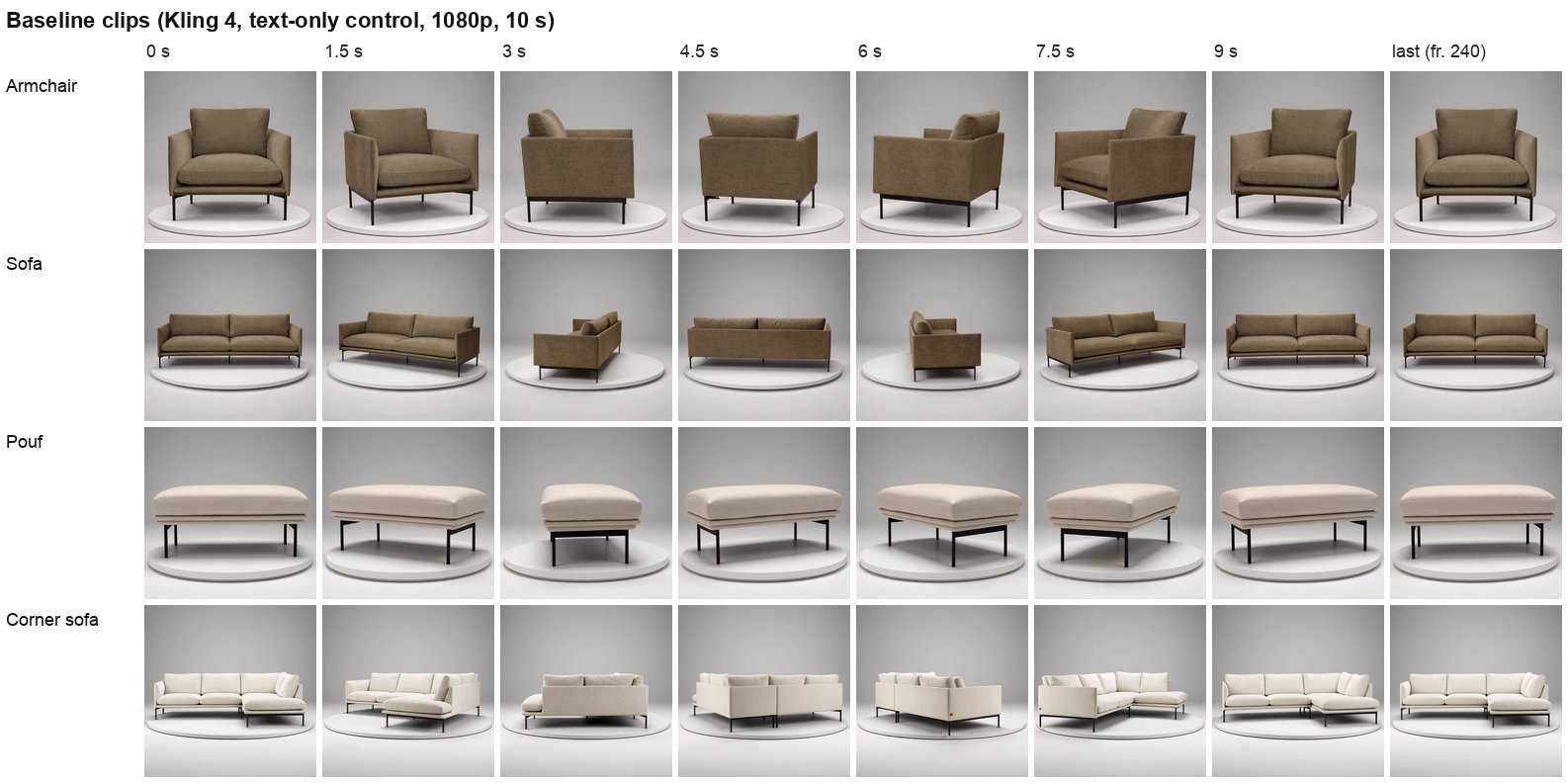
Four clips of the customer's products (Kling 4, 1080p, 1:1, 10 s, text-only control with hidden layer v3): the plate was about the same width on screen in all four and each product was fitted to the frame (armchair about 75% of the plate width, sofa about 90%, pouf filling and overhanging it); first/last SSIM 0.85–0.97 with each clip ending 10–15° short of the front; the corner sofa's chaise end and a rear leg passed over the plate edge in side views. The clips are shown in Figure 19.
7.3 Production clips with the composed frame
Four clips were generated on the production site with Custom framing, Kling 4, 1080p, 1:1, sound on. Settings were varied between pieces to exercise the controls (Appendix B). Checks:
- Output first frame against the composed frame, by visual comparison (the same overlay is available in the product): approximate product/platform layout adherence, and separately backdrop retention.
- Containment, by eye on 34–40 frames per clip, looking at legs and the chaise end against the disc edge.
- Endpoint difference: mean absolute pixel difference between the first frame and the last frame before the hold, on a 0–255 scale. The colour space, resolution, resize method and region of interest used for these clips were not recorded; the anchor-experiment scripts used whole-frame 240 × 240 greyscale images, one converting to grey before an area resize and another resizing (bilinear) before converting, so even those two are not identical.
- Motion: frame difference sampled every 0.2 s, and visual inspection for stepping or deformation.
- Holds: file length and stillness of the end frames.
| Product | Clip | Length | Size | Turntable / thickness / centre (%) | Hold after | Layout adherence (approx.) | Backdrop retained | Over the edge in sampled frames | Endpoint difference |
|---|---|---|---|---|---|---|---|---|---|
| Armchair | Figure 20 (see provenance note) | 10 s | 60% | 80 / 4 / 58 | 2 s | yes (reported) | no: replaced by a darker grey studio | none seen (reported) | not recorded individually |
| Corner sofa | Figure 20 | 10 s | 90% | 80 / 4 / 70 | 2 s | yes | yes | none seen | 0.92 |
| Sofa | Figure 20 | 8 s | 80% | 80 / 10 / 50 | 1 s | yes | yes | none seen | not recorded individually |
| Pouf | Figure 20 | 9 s | 51% | 80 / 5 / 60 | 3 s | yes | yes | none seen | 0.57 |
An internal note gives the range 0.57–1.79 across the four clips, and 1.5–5.5 for frames 0.2 s apart during the turn. The sofa asked for counter-clockwise and turned clockwise. The composed turntable width, thickness, centre height and product size were followed approximately, by eye, in all four; the composed backdrop was retained in three (Section 5.1). No exact whole-frame match count can be derived from these visual checks. Viewed at 0, 2.5, 5 and 7.5 s, the last source frame and the last hold frame, size, plate thickness and plate height differ per piece as set; the corner sofa, sofa and pouf keep the light backdrop, and the armchair is on a darker grey studio from frame 0.
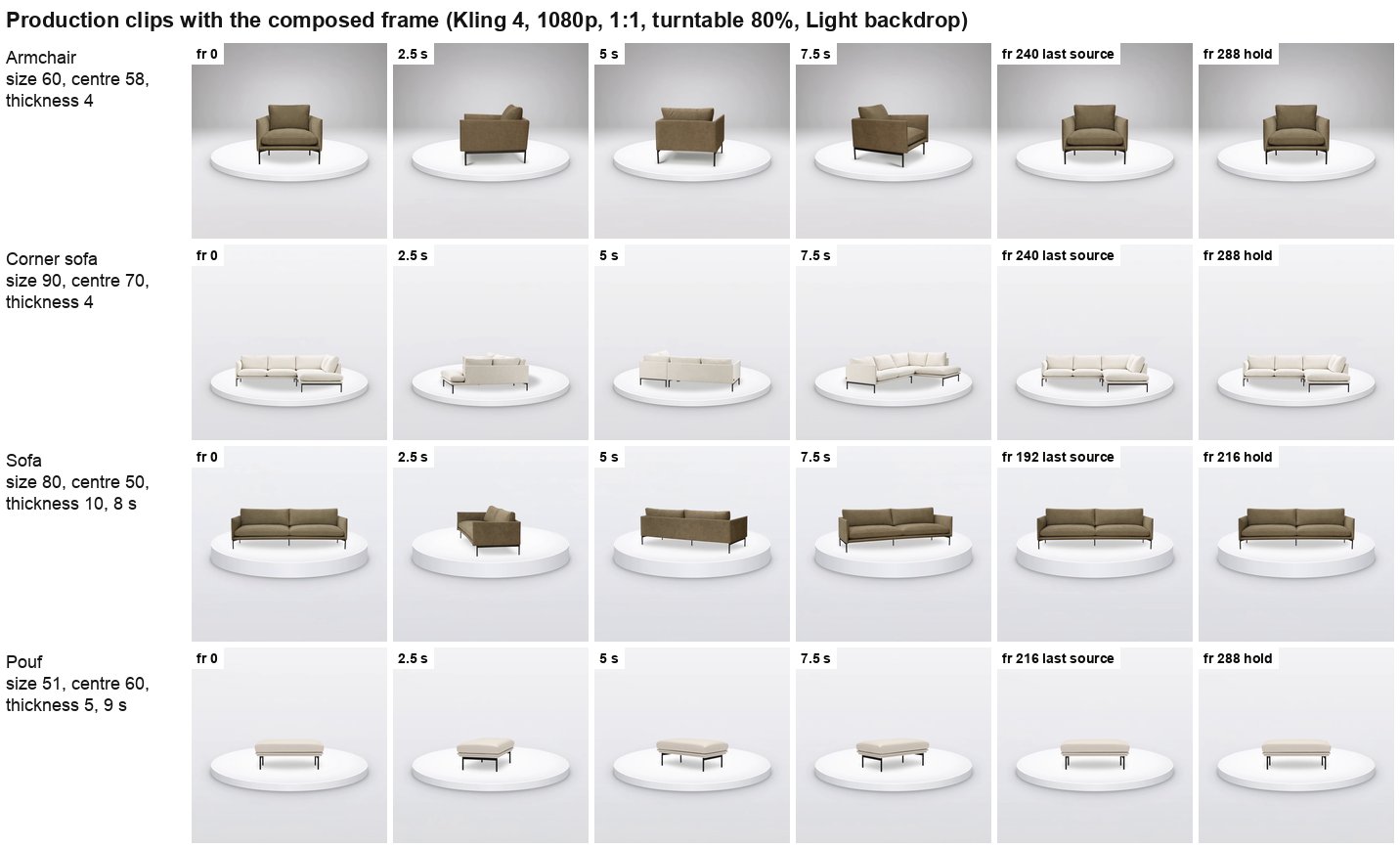
Provenance. The individual endpoint values for the armchair and the sofa, the frames compared, the preprocessing and the scoring command are not recorded. The original evaluation note did not identify the armchair clip unambiguously (a local take and the linked production clip have different settings); a later production record identifies the linked production clip. The armchair's individual endpoint value is still not recorded, so the armchair row and the 0.57–1.79 range are reported internally, not independently reproducible. This is unresolved provenance, not evidence that four production clips did not exist.
What these checks support. No visible containment violation in the sampled frames, not containment throughout the turn: legs can be occluded, and a projected silhouette crossing the drawn ellipse is not the same as a footprint leaving the platform. Visible structural consistency, not fidelity to unobserved real surfaces. A low endpoint difference, not a seamless loop: frames 0.2 s apart are about five frame intervals at 24 fps, not one ordinary step; the two ranges overlap (1.79 > 1.5); and endpoint similarity alone would also be satisfied by a clip that barely moves, reverses, or ends in a similar but wrong pose. Motion continuity across the wrap was not measured, and no viewer test of seam visibility was run. When the clips were sent, the correspondence described the hold as optional because the clips loop seamlessly; that was a claim in correspondence, not a measured result.
| Defect | Baseline (no composed frame) | Production (composed frame) |
|---|---|---|
| R1 size | product fitted to frame; pouf as wide as sofa | size set by the user per piece and visible in the composed frame; same plate width in all four, thickness and position deliberately varied |
| R2 containment | chaise and a rear leg over the edge in side views | corner sofa at 90%: none seen in sampled frames |
| R3 endpoints | SSIM 0.85–0.97, 10–15° short of front | endpoint MAE 0.57–1.79 (reported internally); different metric |
The local armchair take 3 (Section 3.1), measured with SSIM, gave 0.98.
7.4 Metric amendments disclosed
- In the anchor experiment, pass lines were written before the first stage, but an absolute seam threshold (last against first frame ≤ 4 grey levels) was added after the first stage, because the pre-registered seam ratio penalized slowly moving clips, and a reversal metric (an angle track from similarity to four composed views) was added after the second stage, when a reversal was missed by the original metrics.
- The production checks had no pre-written pass lines.
- Loop closure was measured as SSIM on the baseline clips and as mean absolute difference on the production clips. The two are different measures and are not comparable; one protocol applied to both sets is needed (Section 11). A retrospective rescoring of every local clip under one protocol is in Section 7.7; it is observational and does not replace the planned evaluation.
7.5 Start-image layout adherence across runs
| Run | Model | Start image | Clips | Approximate product/platform layout adherence | Backdrop retained |
|---|---|---|---|---|---|
| Anchor experiment, B and C | Kling 3.0 Omni | composed (start = end, or chained) | 6 | 6 of 6 (product width in frame 0 within 0.7%) | not assessed |
| Local take 1 | Kling 4 | flat drawn disc | 1 | 0 of 1 | no (model's own composition) |
| Local takes 2–3 | Kling 4 | photographically shaded disc | 2 | 2 of 2 | not separately recorded |
| Production | Kling 4 | shaded disc with contact shadow | 4 | 4 of 4 | 3 of 4 |
| Redo, start only (Section 7.6) | Kling 4 | shaded disc, Studio grey backdrop | 5 | 5 of 5 at frame 0 (reported); framing then drifted in 1 of 5 | grey studio operator-reported in all 5, seen for this report in the 4 tied to downloaded files; grey levels close to the fitted reference at the points measured (Section 5.1) |
| Redo, start = end (Section 7.6) | Kling 4 | same composed frame as start and end, set by hand | 1 | 1 of 1 | grey studio seen; close at the points measured (Section 5.1) |
Layout adherence here means the product and platform at approximately the composed size and position, judged by eye; it is not a whole-frame match. The six Kling 4 layout successes pool local development runs and production runs with different compositions, prompts and settings. Under an IID assumption the exact binomial 95% lower bound for 6 of 6 would be about 54%, but that assumption does not describe this pooled development sample. The single flat-disc failure followed by shaded-disc successes motivates the hypothesis that the rendering style of the composed frame affects adherence; it does not establish it. In the local takes, with the flat drawn disc (take 1) the output started on a large chair on a large disc; with the shaded disc (takes 2 and 3) it started on the composed small chair and kept that size through the turn. The redo rows are reported separately because their operator measurements were made by a different protocol, because they used a different backdrop (Studio grey against Light; the backdrop-retention counts of the two sets are not pooled), and because frame-0 adherence turned out not to imply that the framing is kept after frame 0 (Section 7.6).
7.6 Framing drift during the turn, and the composed frame as end image
Setting. Six clips made by the operator in the studio after the shading revisions of Section 5: Kling 4 reference-to-video, 1080p, 1:1, 10 s plus a 2 s hold after, Custom framing with turntable 80% of the frame, thickness 4%, centre 58% from the top and the Studio grey backdrop, i.e. the fixed parameters of a redo plan that predates the clips and does not record them. The per-piece size values, the frame-0 PNGs used, whether frame 0 carried a lifted shadow (Section 5), the prompt as sent, and whether the clips were made on production or locally are not recorded. The second bed model's photos are three front and three-quarter views on white, no back or side view.
Results. Plate width (as a percentage of frame width), plate centre (percentage of frame height from the top) and first-against-last SSIM are the operator's measurements, sampled every 0.5 s; the measurement files are not available. The SSIM values in brackets are a check made for this report on the downloaded held copies (1440 × 1440, 24 fps, 289 video frames; video stream 12.041667 s, container 12.120816 s because the audio stream is longer): ffmpeg ssim (Y, "All") on greyscale whole frames, decoded frame 0 against frame 240 at 10.000 s, the last source sample before the 48 hold copies (Section 4.7). Comparing against frame 239 instead changes the values by 0.001–0.002. The two protocols, the operator's and this one, are not known to be the same.
| Product | Clip | Conditioning | Plate width over the clip | Plate centre over the clip | Full turn | First vs last SSIM, reported [this report, frame 0 vs 240] |
|---|---|---|---|---|---|---|
| Bed (second model) | start-only bed clip, not delivered, no public link | start only | 80.0% at 0 s, 89% at 5 s, 97.5% at 8 s, over 100% (past both frame edges) from 9 s | 58% → 67% | turned; last frame about 25% larger than the first, so the loop jumps | not given [0.845, downloaded copy attributed to this clip by content] |
| Bed (second model) | start = end bed clip (Figures 23, 26) | start = end (the same composed frame as First and Last frame) | 80.0–80.1% in every assessable sample; two side-view samples excluded because the bed occludes the plate's widest row, so their width is unassessable | 58.1% | yes, 360° | 0.993 [0.994] |
| Armchair | redo armchair clip (no figure) | start only | 80.1% in every sampled frame | 58.1% | yes | within 0.993–0.996 [no downloaded copy identified with this clip] |
| Sofa | redo sofa clip (Figure 26) | start only | 80.1% | 58.1% | yes | within 0.993–0.996 [0.994] |
| Pouf | redo pouf clip (Figure 26) | start only | 80.1% | 58.1% | yes | within 0.993–0.996 [0.997] |
| Corner sofa | redo corner sofa clip (Figure 26) | start only | 80.1% | 58.1% | yes | within 0.993–0.996 [0.995] |
The delivered clips are tied to the generations by product name only. Samples every 0.5 s over 0–10 s would be 21 per clip; the operator's exact sample count per clip is not recorded, only that two samples of the start = end bed were excluded. The holds of the five delivered clips were reported static, "0–1 grey level" between hold frames; the operator's figure is consistent with a per-frame mean absolute difference, not with a per-pixel maximum. Re-measured for this report on four downloaded clips (Section 4.7): after the first copy, per-frame means of at most 0.010–0.022 and per-pixel maxima of 5–11 grey levels; the armchair has no downloaded copy tied to it. A further downloaded armchair file from the same afternoon gives 0.982 by the check above; it cannot be tied to the delivered armchair clip and is not used.
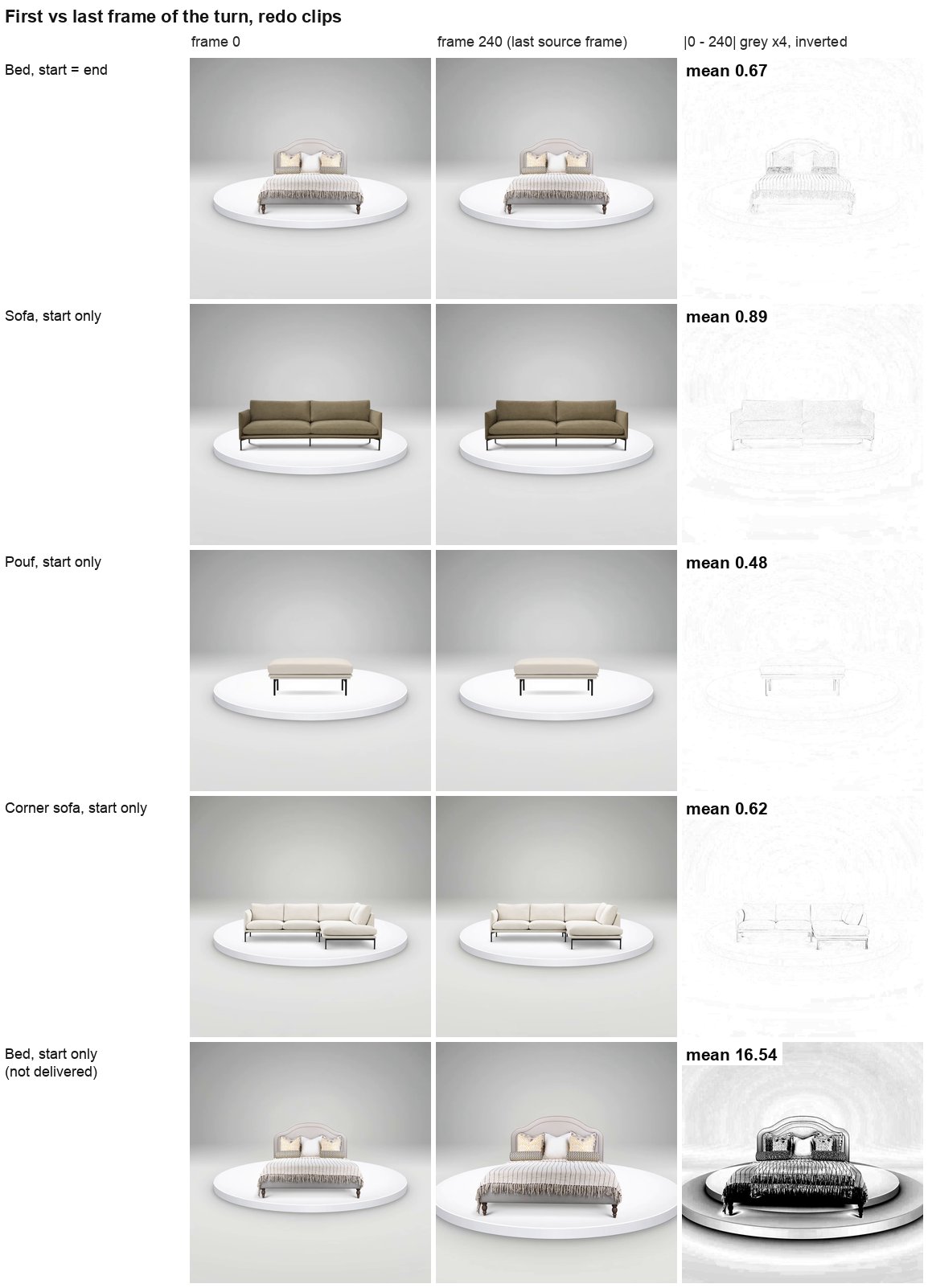
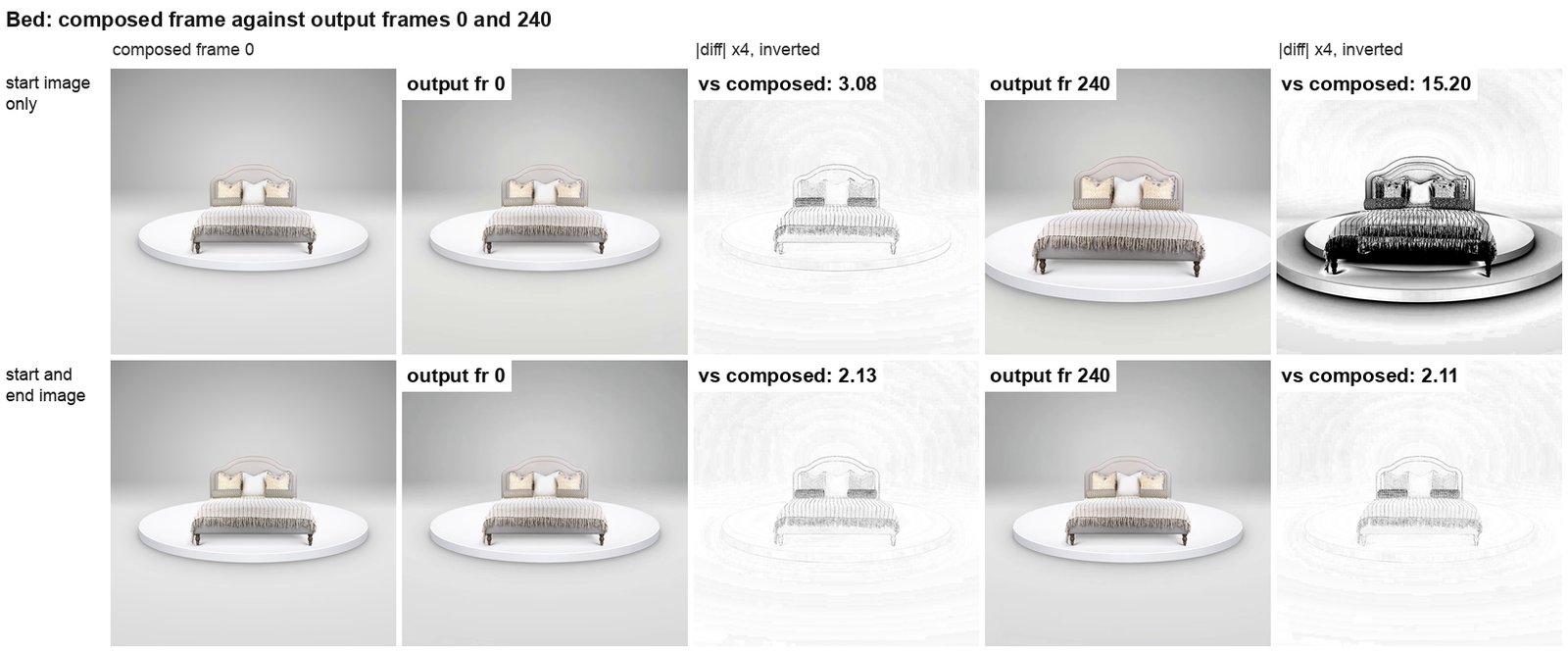
For this report, frame 0 and frame 240 of the five attributable downloaded clips were also compared directly (greyscale, mean absolute difference): the four delivered clips differ mainly along edges (0.48–0.89), while the start-only bed ends visibly larger (16.54). A composed frame of the bed, re-rendered after the start-only clip was made (so at best a re-render of the frame sent for that clip, and only presumed to be the PNG set as First and Last frame for the start = end clip), matches output frame 0 in both clips (mean absolute grey difference 3.08 and 2.13, differences at edges); at frame 240 the start = end clip still matches (2.11) and the start-only clip does not (15.20: larger bed and plate). Viewed every second, the start-only bed grows through the turn, clearly larger from 8 s, until the plate reaches both frame edges at 9.95 s, while the start = end bed keeps the plate size and position at every second.

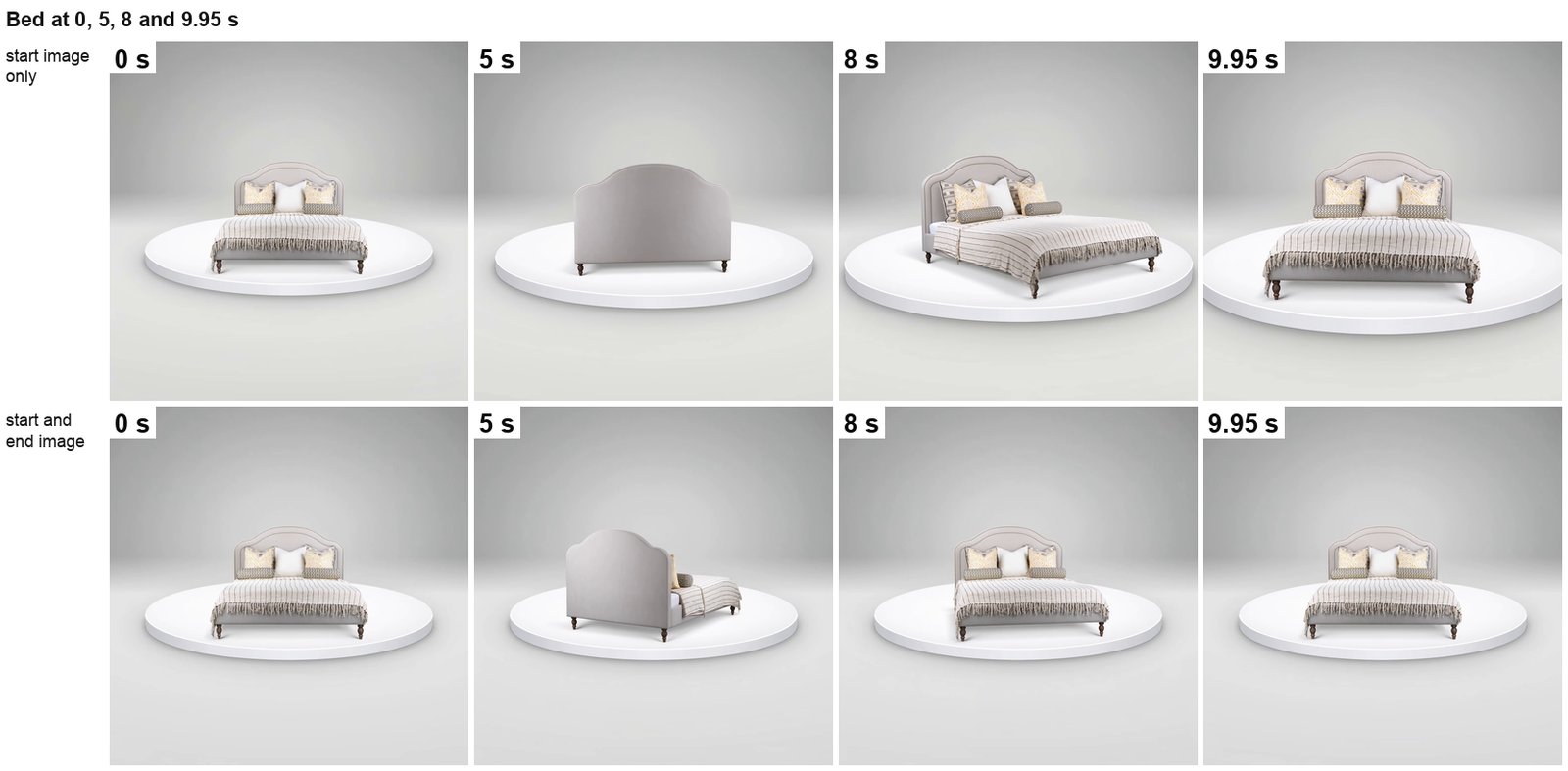
What these clips show. In the start-only bed clip the output first frame followed the composed layout, so frame-0 layout adherence (Section 7.5) held, and the framing was then lost: the camera pushed in steadily through the turn. The prompt's Camera line ("camera position, aim, focal length, focus, aperture and crop stay constant", Appendix A) was in the request as reported and did not prevent it. The four other start-only clips kept the composed framing in every sampled frame, so the drift did not appear in them; it appeared once, on the deepest and tallest piece of the set (the operator's description). Whether it is linked to that shape or is a random event that could hit any piece cannot be decided from one clip per piece, so the run does not say which products are at risk. A within-clip size change had been seen before without a composed frame (one Kling 3.0 Omni baseline clip grew 44% during the turn, Section 3.1), and the clips inspected at the start of the work had stable framing; the earlier composed-frame clips were checked for size during the turn only by eye, and no such drift with a composed start frame had been recorded earlier in this work.
The repeat with the composed frame also sent as end_image_url (Kling 4 accepts it) did not drift, and its plate stayed at the composed width and position in every assessable sample (two occluded side-view samples excluded). This is one take per arm on one product; it shows that the end-frame run did not drift, not that the end image prevents drift. The start-only arm drifted in one of five clips, so a single non-drifting start = end clip is also what an unchanged start-only recipe would often produce. Endpoint conditioning is an objective that favours agreement between the last and the first frame, not a guarantee of it, and its contribution to the observed SSIM of 0.993 (0.994 in the check) is not measured: the four start-only clips reached similar values without it. A high value would be compatible with an unnatural or discontinuous rotation in between, so it does not by itself show a seamless loop (Section 7.3 lists what endpoint similarity cannot show).
Open risk: no turn. With identical start and end images, ending where it began is also satisfied by a product that does not turn, or that turns part way and returns. The bed turned a full circle in its one take, and so did the automatic start = end armchair clip (below, Figure 27). With sampling every 0.5 s, a brief overshoot or reversal between samples is not excluded; no reversal metric (Section 7.4) was run. Observed once under each of two settings, not shown to hold.
Relation to the start = end anchor condition. That experiment used Kling 3.0 Omni at 720p, the green armchair, and anchor frames composed by separate scripts; one of its three start = end clips overshot and returned, and work on that model was stopped for that reason. The present clip differs in model (Kling 4), resolution (1080p), product (a bed), composition (the studio's own composer with the Studio grey backdrop) and purpose (holding the framing, not closing the loop). The two are not comparable and this clip does not contradict the earlier failure: start = end conditioning has now produced a reversal in one of three clips on one model and a full turn in each of two clips on another (one set by hand, one automatic, Section 7.6 and below), which is not a rate on either.
Early arrival and a longer pause (open observation). In the start = end bed clip the bed reached the front pose at about 9.0 s rather than at the end of the 10 s turn: SSIM against the first frame was 0.904 at 8 s, 0.929 at 8.5 s and 0.993 at 9 s, and from 9 to 10 s the bed stood nearly still (frame-to-frame change about 0.05, against about 1.0 while turning; units as measured by the operator). With the 2 s hold appended, the visible pause was therefore about 3 s instead of the requested 2 s. The pouf, made without an end image, did the same, reaching the front at about 8.5 s, so its visible pause was about 3.5 s; the corner sofa, sofa and armchair reached the front only at 10 s. The arrival times are approximate and rest on pose similarity to frame 0; the stillness before the end of the turn is the operator's frame-to-frame figure, not a measured stationary segment. These figures are the operator's; the measurement files are not available. A check for this report on the downloaded held copies (greyscale SSIM of the frame decoded at each time against decoded frame 0, by seeking) gave 0.920, 0.931 and 0.992 at 8, 8.5 and 9 s for the start = end bed, 0.987 and 0.996 at 8 and 8.5 s for the pouf, and 0.961, 0.978 and 0.995 at 9, 9.5 and 10 s for the corner sofa, consistent in pattern with the operator's values but by a different protocol. A per-frame series computed for this report (SSIM against frame 0 at full resolution; mean frame-to-frame change on 480 px greyscale) reproduces these spot values; for the bed the frame-to-frame change falls from a mean of 1.30 over 1–8 s to 0.054 over 9–10 s, the same pattern as the operator's "about 1.0 against 0.05" on a different scale, and the start-only bed's SSIM against frame 0 stays near 0.84–0.85 to the end. Since one clip without an end image showed the same early arrival, and the automatic start = end armchair clip (below) did not arrive early (0.42 s before the end): one of the two start = end clips reached the early-arrival threshold and one did not, so its relation to the end image remains uncertain; one clip each does not show how often it happens. A possible remedy, not built, is to detect the still segment before the end of the turn and trim it, so that the appended hold is the only pause.
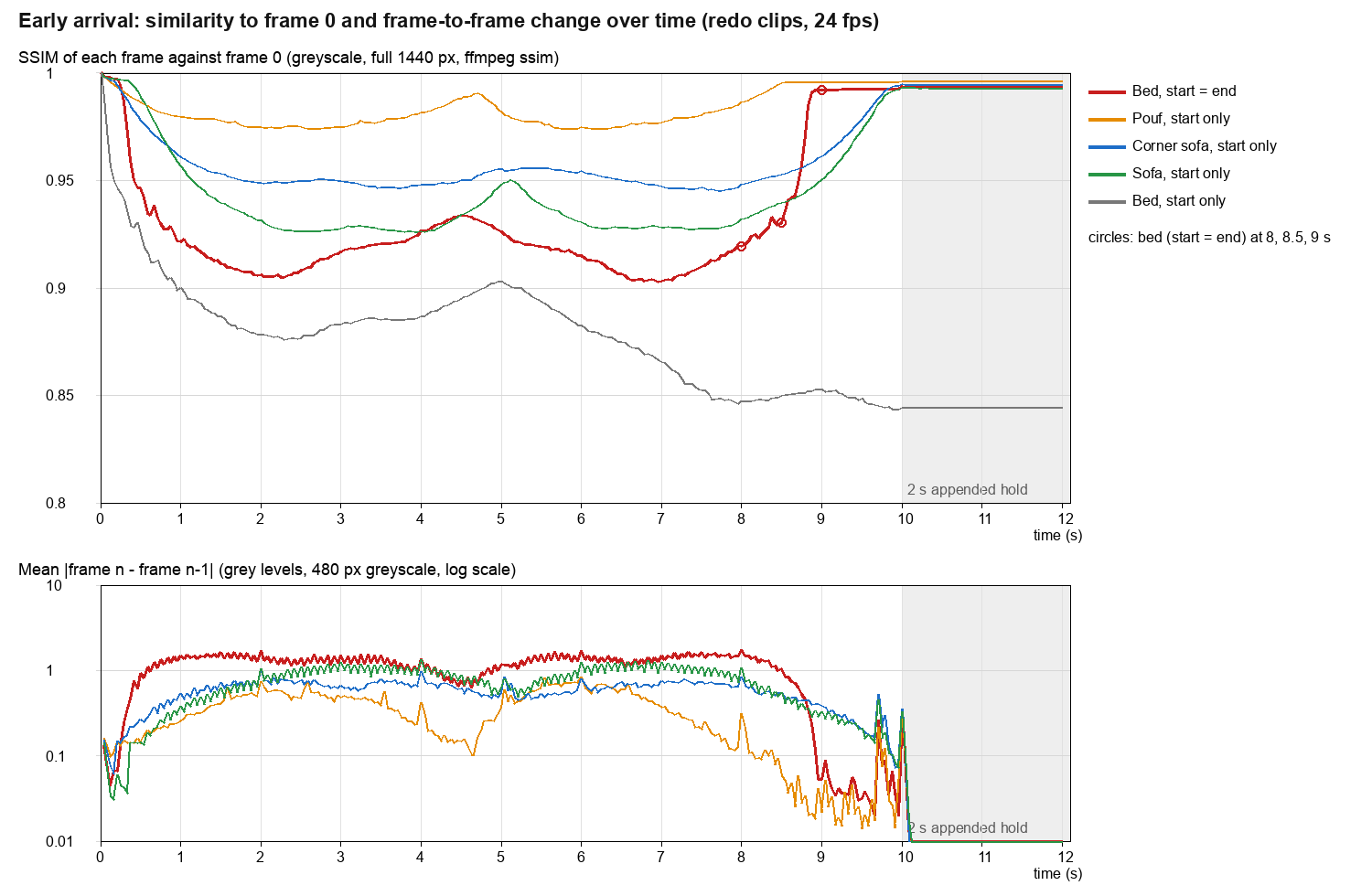
Status. In the measured clip the end image was set by hand: the composed frame PNG was put in the studio's First frame and Last frame slots, which takes the user-first-frame path rather than the automatic composed-frame upload. After this clip, sending the composed frame as the end image automatically was built and deployed (Section 4.4): on Rotation Auto or 360° it is now the default with Custom framing. It does not apply to 270° rotation, whose end pose differs from the start; Swing ±90° returns to 0° and could use it, but has not been tried and is excluded. The decision to ship rests on this single paired comparison and on product judgement; it is not evidence of the effect, and the risks above (no turn, early arrival) apply to every clip made through the automatic path. One such clip is recorded so far (the armchair below): it turned a full circle, did not arrive early and held the framing, while its start-only twin pushed in.
Delivery. Five of these clips (all except the drifting start-only bed) were sent to the customer as public links with self-serve steps, as reported by the operator. The customer's verdict has not been received, and nothing in this report should be read as acceptance.
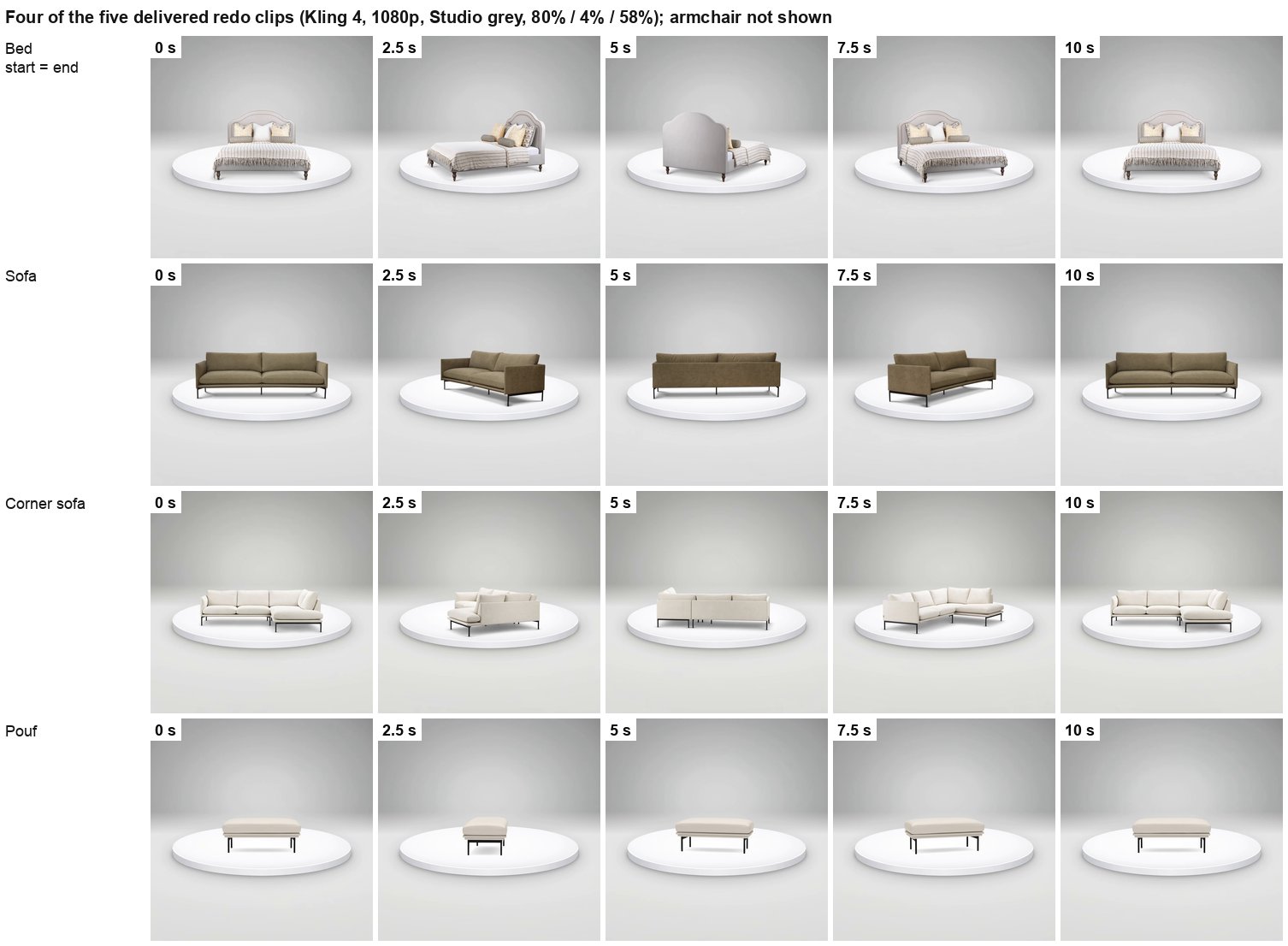
A second pair, made through the automatic path. Shortly after the automatic end image was deployed, the operator made two clips of the green armchair of the anchor experiment (Section 3) in the studio with identical settings: Kling 4 reference-to-video, 720p, 1:1, 10 s plus a 1 s hold, size 50%, turntable 80%, thickness 4%, centre 70% from the top, Studio grey, Rotation Auto, five photos (four in the product element, one plain reference). The first was presumably made in a studio page loaded before the deployment and not reloaded (the page's load time is not recorded); the second after a reload, with the automatic first- and last-frame tiles visible, so the composed frame went as start and end image. That the first clip carried no end image is inferred from the timing and the page state, not read from the request, because the generation record does not show whether an end image was sent. The downloaded outputs (940 × 940, 265 frames = frames 0–240 of the 10 s source plus 24 hold copies) were first scored as unattributed in Section 7.7 and tied to these two generations afterwards from the session record. Because the first clip's start-only condition rests on inference, this is an approximately matched pair whose condition attribution partly rests on inference. Measured with the protocol of Section 7.7 (E = frame 240):
| Product | Clip | Conditioning | Plate width over the clip | Plate centre over the clip | Full turn | Frame 0 vs 240: SSIM / MAE |
|---|---|---|---|---|---|---|
| Green armchair | start-only armchair clip (Figure 27) | start only (inferred) | 80.1% at 0 s, 91.2% at 1 s, past both frame edges from 1.25 s to the end | 70.2% → 83.1% (range 70.2–83.3%) | turned while the camera pushed in to a close-up; never returns to the front-like threshold of Section 7.7 | 0.832 / 24.68 |
| Green armchair | start = end armchair clip (Figure 27) | start = end (automatic) | 80.1% in all 41 samples (every 0.25 s) | 70.1–70.2% | yes, front → side → back → side → front by eye | 0.993 / 1.89 |
The operator's measurements at the time (every 0.5 s, protocol unrecorded) agree in direction: 81% rising past the frame edges by about 3 s for the start-only clip; 79.9% and 70% throughout, first against last SSIM 0.991 and a static 1 s hold for the start = end clip. They differ in when the plate first passes the frame edges (about 3 s against 1.25 s here); Section 7.7 uses the values in the table. The start = end clip reached the front-like threshold 0.42 s before the last source frame, so it did not arrive early (Section 7.7 counts 1 s or more). Its seam ratio is 4.05 at an absolute seam of 1.89 grey levels, because the small armchair moves little per frame (median step 0.47); read together, as Section 7.7 asks, the ratio overstates the jump.
This repeats the bed pair's one-variable change on a second product, at a second resolution (720p against 1080p) and a second plate height (70% against 58%), and through the automatic path rather than by hand, with the same outcome: the start-only arm pushed in, the start = end arm held the composed framing. It is still one take per arm. The start-only drift here came earlier and was stronger than the bed's; across these clips the start-only recipe drifted in two of six (the bed and this armchair) and held in four.
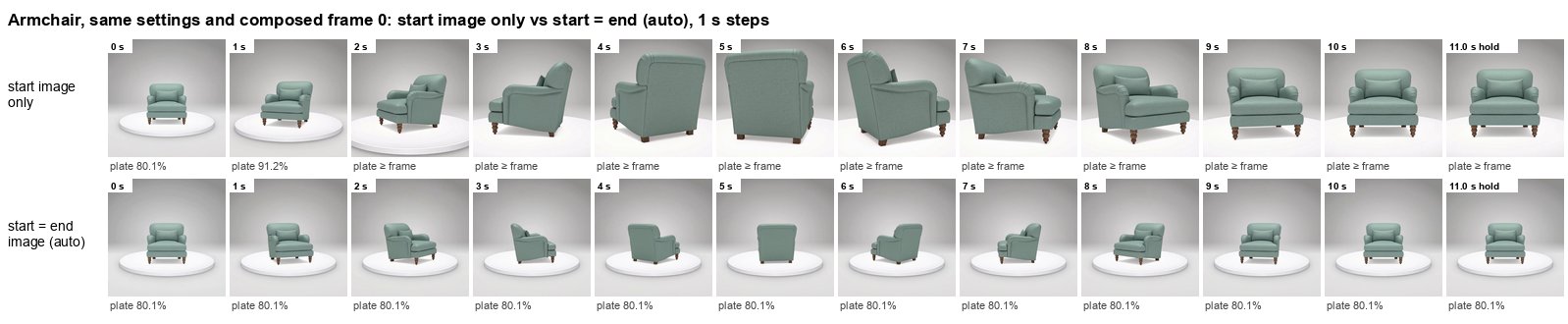
Interpretation, kept to these two pairs. Framing is a geometric constraint (the same size at the same place). The start-only bed take drifted, although it already carried the composed start image as well as the prompt's words; the subsequent take conditioned on the same image at start and end did not. The same happened on the green armchair at 720p through the automatic path. The intervention's effect and the source of the variation remain unknown: two pairs of one take per arm cannot separate the end image from take-to-take variation. This is compatible with, but does not test, the report's main observation that layout reaches the model through images rather than text (Section 12); the controlled test is ablation 5 of Section 11.
7.7 Retrospective comparison
Status. After Sections 7.2–7.6 were written, every locally available turntable clip of this work was rescored with one protocol, from local files only, with no new generation and no paid service. The comparison is retrospective and observational. The clips were made before the protocol existed, under settings varied deliberately or adaptively, mostly one clip per condition. Nothing in this section is a rate, an effect size or a causal result, and where a condition has n = 1 the number describes that clip only. It answers the need for one protocol across sets raised in Section 7.4; it does not replace the controlled evaluation of Section 11.
Protocol (identical for every clip). Decode: ffmpeg, every decoded frame (passthrough timing, no duplication), area-scaled to 512 × 512 px (all clips are square), YUV→RGB matrix forced to BT.709 limited range whatever the file's tag (some files are untagged), 8-bit RGB; grey = 0.2126 R′ + 0.7152 G′ + 0.0722 B′ (the Rec.709 luma weights applied to the gamma-encoded values), float, 0–255. Composed start images: alpha over white, area resize to 512 px, the same weights. Motion end: the motion segment is frames 0…E, where E is the last source frame before an appended hold. E is taken from the recorded file structure (raw outputs: the last frame; held files: frame 240 for a 10 s source, 192 and 216 for the production sofa and pouf). A detector is run on every clip but used only where nothing is recorded (in the final set, no clip): a hold is the trailing run of frames whose adjacent-frame MAE is below 0.03 grey levels (one keyframe blip below 0.25 tolerated), and E is the frame before that run. It agrees with the record within one frame on the held files, misses the production pouf (240 instead of 216, broken by two keyframe blips) and flags a 16-frame still tail in the raw, unheld local take 2 that the model made itself, so a still-run detector cannot tell an appended hold from the model's own stop. Regions: whole frame, and a fixed centre box (rows 20–80%, columns 25–75%; the same for every clip, not a product mask). Metrics: (1) endpoint SSIM [27] (Gaussian window 11 × 11, σ 1.5, K1 0.01, K2 0.03, L 255, reflect padding, mean over the region) and MAE of frame 0 against frame E; (2) seam MAE = MAE(frame E → frame 0), the step a viewer sees when the motion segment loops, median adjacent step inside 0…E, and seam ratio = seam MAE ÷ median step (1 = an ordinary step; the anchor experiment's pass line was ≤ 2.0); for held files this is the loop of the motion segment, not of the held file; (3) framing drift: a plate detector on every 6th frame (0.25 s) plus E, which measures the lit top of the plate (width as % of frame width, centre as % of frame height), validated on composed images of known geometry (frames set to 76 / 56 read 76.0 / 56.0–56.2; 80 / 58 reads 80.1 / 58.1; 80.0 / 77.9 reads 80.3 / 79.0), with every clip's first and last motion frame checked by eye and graded ok (20 clips), edge (the plate reaches a frame edge, so width is a lower bound; 20) or unreliable (7), and widths reported only for ok; plus a detector-free product-top row whose range over the clip is reported where valid; (4) layout against the composed start image, where it was stored: MAE and SSIM against output frame 0, plate width and centre differences, and MAE against frame E; (5) a partial rotation reading: centre-box SSIM of every 2nd frame against frame 0, giving the time of least similarity, a front-like threshold (min + 0.8 (1 − min)), how many seconds before E the clip reaches it again (early arrival), mid-clip samples above it, and the still tail inside the motion segment. Reading (5) does not measure direction: a reversal that never passes the front is invisible to it, and the anchor experiment's own reversal metric is quoted, not recomputed.
Clips. After removing byte-identical duplicates, 46 clips tied to the groups of this report were scored (two of them, the armchair pair of Section 7.6, first scored as unattributed and tied to their generations afterwards, with the end frame then taken from their settings); files that could not be tied to a recorded generation were excluded from every comparison. For the anchor experiment the raw provider outputs were scored rather than later re-encodes.
| Group | n | Endpoint SSIM, whole: median [min–max] | Endpoint MAE, whole | Seam ratio |
|---|---|---|---|---|
| Platform template examples | 2 | 0.514 [0.183–0.846] | 52.04 [6.30–97.78] | 31.84 [3.06–60.62] |
| Customer's own first clips | 5 | 0.906 [0.717–0.989] | 6.52 [1.46–16.46] | 3.11 [0.96–8.24] |
| Prompt v8 tests | 6 | 0.910 [0.849–0.969] | 4.16 [1.51–11.72] | 2.40 [0.55–12.92] |
| Hidden-layer takes | 5 | 0.904 [0.775–0.989] | 3.75 [1.17–16.21] | 1.01 [0.34–5.67] |
| Baseline, no composed frame (Section 7.2) | 4 | 0.930 [0.860–0.988] | 4.21 [1.54–5.51] | 1.99 [0.91–2.24] |
| Generated four-view reference set | 1 | 0.967 | 1.93 | 2.49 |
| Anchor experiment, Condition A (prompt only) | 3 | 0.899 [0.784–0.919] | 7.61 [7.08–21.65] | 10.55 [5.26–14.10] |
| Anchor experiment, Condition B (start and end image) | 3 | 0.996 [0.986–0.996] | 1.79 [1.73–1.93] | 1.98 [1.56–2.20] |
| Anchor experiment, Condition C (chained) | 3 | 0.994 [0.993–0.994] | 4.06 [3.47–4.69] | 5.52 [4.90–6.00] |
| Local composed-start takes | 3 | 0.995 [0.985–0.996] | 1.36 [1.12–1.58] | 3.29 [0.70–4.16] |
| Production, composed start (Section 7.3) | 4 | 0.995 [0.994–0.997] | 0.66 [0.41–1.24] | 1.15 [1.09–1.43] |
| Redo, start image only (Section 7.6) | 4 | 0.996 [0.803–0.996] | 0.69 [0.44–16.08] | 1.29 [0.96–10.39] |
| Redo, start and end image (Section 7.6) | 1 | 0.996 | 0.50 | 0.41 |
| Armchair pair, start image only (Section 7.6) | 1 | 0.832 | 24.68 | 11.78 |
| Armchair pair, start and end image, automatic (Section 7.6) | 1 | 0.993 | 1.89 | 4.05 |
Groups pool clips whose product, model, resolution, prompt and settings differ (Figure 28). The anchor-experiment MAE values reproduce that experiment's own endpoint differences (21.8 / 7.7 / 7.2; 2.1 / 1.9 / 1.9; 3.5 / 3.9 / 4.5) within 0.2 grey levels, by a different decode and size.
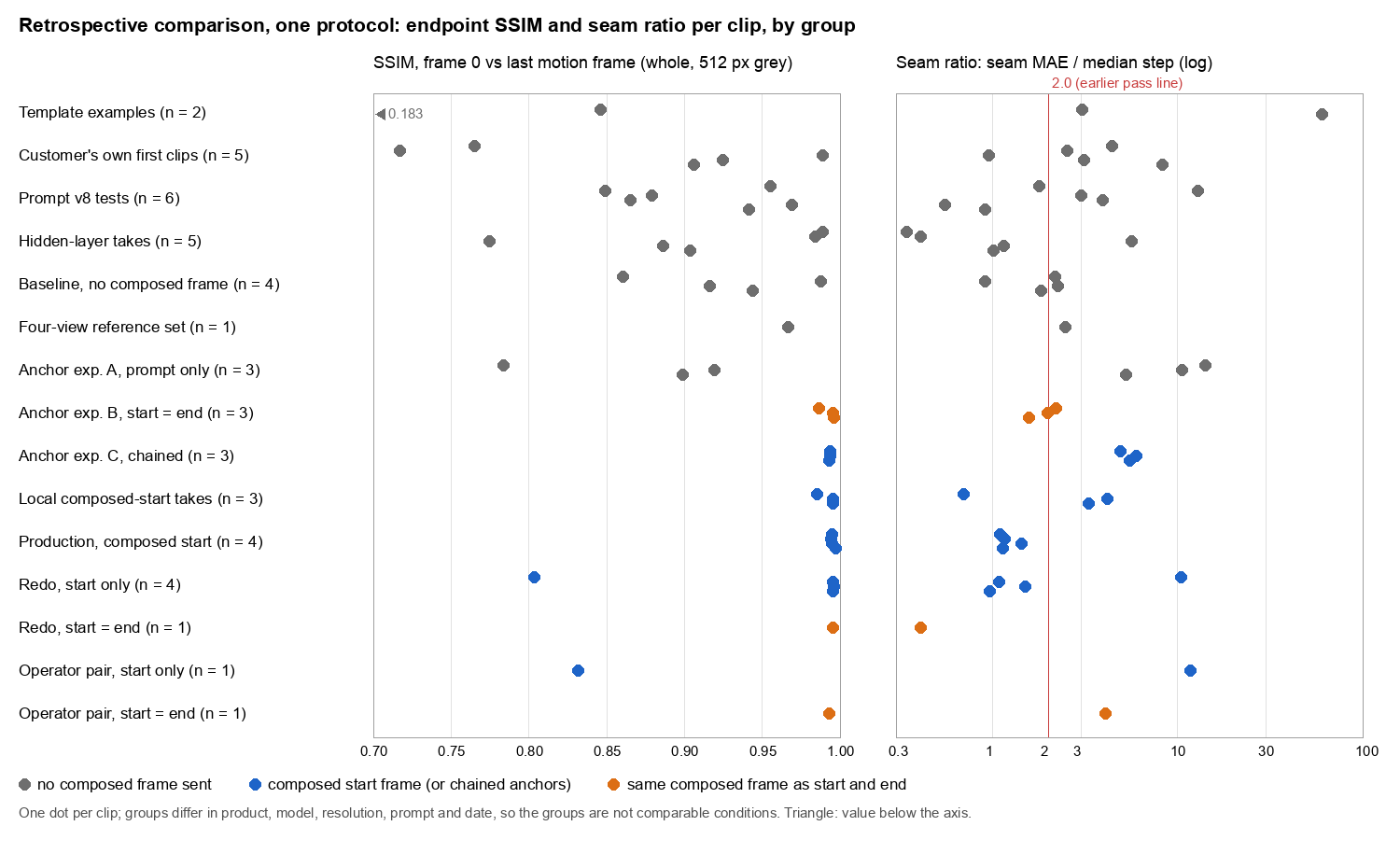
Near-matched pairs. Only six comparisons in the whole set differ in one recorded factor. Each is n = 1 per arm except the anchor-experiment comparison (n = 3 per arm). P3 and P6 test the same change, the composed frame added as end image, on two products and two resolutions, set by hand and automatically. Unrecorded differences (seed, provider-side state) are uncontrolled in every pair.
| # | Pair | The one recorded factor that differs | Held the same | Endpoint SSIM / MAE / seam ratio | Framing and layout | Rotation reading |
|---|---|---|---|---|---|---|
| P1 | Anchor experiment, Condition A vs Condition B (n = 3 + 3) | composed front frame sent as start and end image (requests otherwise identical) | Kling 3.0 Omni 720p silent 10 s, green armchair, five photos, prompt text | A 0.784 / 0.920 / 0.899; 21.65 / 7.61 / 7.08; 14.1 / 10.5 / 5.3. B 0.986 / 0.996 / 0.996; 1.93 / 1.79 / 1.73; 2.20 / 1.98 / 1.56 | B plate 80.1% / 79.0% in every sample; A plate unreliable (two clips) or past the frame edge (one); product-top range A 15.0 / 2.7 / 3.1 pts, B 2.0 / 1.2 / 1.2; frame 0 vs composed front MAE A 24.7 / 24.2 / 24.2 (front not sent), B 2.4 / 2.8 / 3.1 | one B clip has 2 mid-clip front-like samples, consistent with its recorded overshoot; one A clip's recorded swing back is not visible to this reading |
| P2 | Local take 1 vs take 2 | composed disc drawn flat vs shaded | Kling 4 720p 10 s, armchair, size 50 / plate 76 / centre 56 / thickness 3, endpoint, prompt, settings | 0.985 vs 0.995; 1.12 vs 1.58; 0.70 vs 4.16 | take 1 plate past the frame edge (the model's own composition), frame 0 vs composed MAE 54.4, width +24.0 pts; take 2 76.0–76.2% / 56.2–56.7%, MAE 3.4, width 0.0 | take 2 has a 0.6 s model-made still tail, which lowers its median step and inflates its seam ratio |
| P3 | Redo bed, start image only vs start and end image | the same composed frame also sent as end image (set by hand) | Kling 4 1080p 10 s + 2 s hold, second bed model, plate 80 / 4 / 58, Studio grey, prompt as reported | 0.803 vs 0.996; 16.08 vs 0.50; 10.4 vs 0.41 | start only: 80.1% at 0 s, then past both frame edges, centre 58.1 → 63.2%; start and end: 79.7–80.1% / 57.5–59.2%; frame 0 vs composed MAE 4.09 vs 3.17, frame E vs composed 14.57 vs 3.17 (composed image presumed, Figure 22) | start and end: front-like threshold reached 1.17 s before E |
| P4 | Prompt v8 armchair tests T4 vs T4b | reference set: five photos (fifth routed as a separate reference) vs four photos in the element | Kling 4 720p 10 s, prompt v8, green armchair | 0.969 vs 0.941; 1.51 vs 2.30; 0.55 vs 0.91 | both plates past the frame edges (n/a) | T4 starts and ends on the back (Section 3.1), so its better endpoint numbers do not check the start pose |
| P5 | Prompt v8 blue sofa on Kling 3.0 Omni vs Kling 4 | model (and with it output size, 960 vs 940 px, and sound per model) | prompt v8, blue sofa, photos, 720p, 10 s | 0.849 vs 0.879; 11.72 vs 5.89; 12.9 vs 3.0 | both plates at the frame edges (n/a) | neither returns to the front-like threshold |
| P6 | Armchair pair, start image only vs start and end image | the composed frame also sent as end image (automatic; its absence in the start-only clip is inferred, Section 7.6) | Kling 4 720p 10 s + 1 s hold, green armchair, five photos, size 50, plate 80 / 4 / 70, Studio grey, Rotation Auto | 0.832 vs 0.993; 24.68 vs 1.89; 11.8 vs 4.05 (median step 2.09 vs 0.47, so the 1.89-level seam reads high as a ratio) | start only: 80.1% at 0 s, 91.2% at 1 s, past both frame edges from 1.25 s, centre 70.2 → 83.1% (range 70.2–83.3%); start and end: 80.1% / 70.1–70.2% in all 41 samples; composed image not stored | start only never returns to the front-like threshold; start and end reaches it 0.42 s before E, no mid-clip front-like sample |
Every other comparison differs in more than one recorded factor: local take 2 vs take 3 (contact shadow, a new Motion line and the browser hold, bundled); anchor Conditions B vs C (chaining, segment prompt, end anchors, length); baseline vs production per product (composed frame, prompt layer, backdrop, size, plate, length and hold); production vs redo per product (backdrop, thickness, centre, size, hold, shadow, prompt state); the redo start-only clips among themselves (product only, but n = 1 per product, so differences cannot be separated from take-to-take variation); the customer's two cream-sofa clips (model, length, sound); the prompt v8 tests vs Condition A (product, photos, model, request assembly); Conditions A/B vs the redo start-and-end bed (model, resolution, product, composer, backdrop, prompt); and the hidden-layer takes among themselves (layer version, product, resolution, rotation mode).
Readings, kept to what the numbers show. Endpoint similarity alone does not separate the problems: a hidden-layer take recorded as reversing at 180° scores endpoint SSIM 0.989 (MAE 1.17), the highest outside the composed-frame groups; T4, which starts and ends on the back, beats T4b on every endpoint number; Swing clips that return to the front score like loops. Endpoint SSIM and MAE check only that the last motion frame resembles the first, nothing about the turn. Within the observed clips, the clips with a composed start that the model followed (Conditions B and C, local takes 2–3, production, the redo clips except the start-only bed, and the start-and-end armchair clip; n = 17) have endpoint SSIM 0.986–0.997 and MAE 0.41–4.69, and the prompt-only clips (customer, prompt v8 tests, hidden-layer takes, baseline, four-view reference clip, Condition A; n = 24) have SSIM 0.717–0.989 and MAE 1.17–21.65; product, model, resolution, prompt and date all differ between these groups, so this describes the sample, not an effect. Framing drift was seen both without a composed frame (a Condition A clip's product top moves 15 points; another's plate is past the frame) and with one (the start-only arms of P3 and P6). Of the 20 clips with a usable plate reading, 16 keep plate width within 0.8 points and centre within 1.7 points over the motion segment; the two production sofas move 2.3–2.5 points in width and 2.1–4.0 in centre, plausibly because the sofa covers the plate's widest row in side views (a detector limitation, not shown to be camera motion); the redo start-only bed (20.7 points of width and 5.1 of centre before the plate leaves the frame) and the start-only armchair (19.9 and 13.1, past the frame from 1.25 s) are the two push-ins among the scored clips, and in both pairs the start-and-end twin held the plate. Seam ratio depends on how fast a clip moves: the chained Condition C clips (median step about 0.7) read 4.9–6.0 with seams of 3.5–4.7 grey levels, and local take 2's model-made still tail gives 4.16, so ratio and absolute seam MAE have to be read together. Early arrival (front-like threshold reached at least 1 s before E) appears in the redo start-and-end bed (1.17 s), the redo pouf (1.75 s) and one hidden-layer take (1.00 s); the automatic start-and-end armchair reaches it only 0.42 s before E, so of the two start-and-end clips one arrived early and one did not.
Where these numbers differ from numbers elsewhere in this paper. None of the earlier values is replaced; each belongs to its own protocol, and the values are not interchangeable across protocols.
- Redo clips, frame 0 against frame 240: this protocol (512 px, the SSIM implementation above on Rec.709 grey) gives 0.996 for the start-and-end bed, the sofa, the pouf and the corner sofa, and 0.803 for the start-only bed. Section 7.6's check (ffmpeg
ssim, Y, 1440 px, frame 240) gives 0.994 / 0.994 / 0.997 / 0.995 / 0.845; the operator's values (protocol unrecorded) are 0.993 for the start-and-end bed and within 0.993–0.996 for the start-only clips. - Redo clips, frame 0 against frame 240, MAE: 0.44–0.79 for the four delivered clips and 16.08 for the start-only bed here, against 0.48–0.89 and 16.54 in Section 7.6 and Figure 21 (the figure set's greyscale decode).
- Composed bed frame against output: frame 0 MAE 4.09 (start only) and 3.17 (start and end), frame E 14.57 and 3.17 here, against 3.08 / 2.13 and 15.20 / 2.11 in Figure 22 (the figure set's comparison at its own size).
- Armchair pair: start-and-end clip, frame 0 against frame 240 SSIM 0.993 here against the operator's 0.991 (protocol unrecorded); start-only clip, plate past the frame edges from 1.25 s here against about 3 s in the operator's 0.5 s samples.
- Plate geometry of the four delivered redo clips: 79.3–80.1% width and 57.0–59.2% centre over the turn by this detector, against the operator's 80.1% / 58.1% in every sample (Section 7.6).
- Early arrival: the start-and-end bed 1.17 s and the pouf 1.75 s before E here, against about 1 s and 1.5 s from the operator's and Section 7.6's spot SSIM values.
- Production endpoint MAE: corner sofa 0.62 and pouf 0.41 here, against 0.92 and 0.57 in Section 7.3 (protocol unrecorded); the armchair (0.70) and sofa (1.24), not recorded individually in Section 7.3, are measured here, so the four-clip range is 0.41–1.24 by this protocol against the internally reported 0.57–1.79.
- Baseline endpoint SSIM: 0.860–0.988 here (the sofa is 0.988), against 0.85–0.97 in Section 7.2 (the baseline's own protocol).
- Local take 3: 0.996 here against 0.98 in Section 7.3.
- Anchor experiment MAE: within 0.2 grey levels of its own endpoint differences (above).
- T4 and T4b seam ratio: 0.55 and 0.91 here, against 0.49 and 0.88 (whole frame) in the anchor experiment's calibration and 1.0 and 1.5 (centre crop) in the earlier analysis (Section 3.1).
Caveats. The comparison is observational: every clip predates the protocol, and no clip was made to test it. The groups are confounded: product, model, resolution, prompt version, composition, backdrop and date change together between them, so differences between groups cannot be attributed to the composed frame or to anything else. Endpoint SSIM alone misleads: a reversed take scores 0.989 and a back-started take (T4) beats its pair, so endpoint numbers are read together with the framing, seam and rotation readings and with the frames themselves. Cells are small: n = 3 per arm in P1, n = 1 per arm in P2–P6 (the end-image change has two such pairs, on two products), n = 1 for each start-and-end clip of Section 7.6, and one clip per product in the redo start-only group. The plate detector measures the lit top and can read a few points narrow on shaded plates, and products that cover the plate's widest row move its chosen row; the rotation reading does not measure direction. Two clips discussed in this paper have no local copy and are not scored (the numeric-Layout clip and the redo armchair), and composed start images were not stored for the production and redo start-only clips, so the layout reading is unavailable for them. No causal claim is made from any of these numbers.
8. Comparison with alternatives
8.1 Approaches tried (details in Section 3)
| Approach | R1 size | R2 containment | R3 endpoints | Reversal | Moving sequence model-generated | Status |
|---|---|---|---|---|---|---|
| Prompt wording and hidden layers (Kling 3.0 Omni, Kling 4) | not controlled | failed on corner sofa | SSIM 0.85–0.97, short of front | — | yes | dropped |
| Numeric Layout line only (Kling 4, 1 clip) | ignored | — | — | — | yes | dropped |
| Composed start = end frame (Kling 3.0 Omni, 3 clips) | 3/3 within 3% | 3/3, 16 frames by eye | 3/3 ≤ 4 grey levels | 1/3 overshot and returned | yes | stopped |
| Four chained 90° clips (Kling 3.0 Omni, 3 clips, 12 provider calls) | 3/3 | 3/3, 16 frames by eye | 2/3 ≤ 4 grey levels | 1/3 reversed | yes | stopped |
| Generated four-view reference set (Kling 4, 1 clip) | — | none seen in sampled frames | endpoints near front, not coincident | — | yes; structural drift | dropped |
| 3D render | explicitly controllable in a correctly configured scene | controllable (scene and trajectory) | controllable (periodic trajectory) | controllable | no | not run |
| Composed start frame (Kling 4, shipped) | set by user in frame 0; layout followed approximately in 6/6, backdrop retained in 3/4 production clips; redo run: frame 0 followed in 5/5, framing then drifted until the plate left the frame in 1/5 (bed) | 4/4 none seen in sampled frames | MAE 0.57–1.79, 4/4 (reported internally); redo SSIM 0.993–0.996 in 4/5, bed 25% larger at the end | 0 seen in default direction; 1/1 non-default direction ignored | yes | live |
| Composed frame as start and end image (Kling 4, 2 clips: bed set by hand, armchair automatic) | framing kept in every assessable sample in both (two occluded side views of the bed excluded) | not assessed separately | SSIM 0.993 bed (operator), 0.993 armchair (Section 7.7 protocol), partly the conditioning itself; bed front reached about 1 s early, then nearly still; armchair not early | full turn in both, none seen at the sampling used; not measured | yes | automatic on Auto / 360° since the same evening; one automatic-path clip recorded (the armchair) |
The thresholds and products differ between rows, so the table is not a controlled comparison. The start = end condition on Kling 3.0 Omni met the same three named defects in its three clips under its own thresholds; its failure was the additional reversal criterion, and work on that model was stopped. With Custom framing and a cut-out there are now three request paths: the composed frame as start image only (270° and Swing, or a model without an end image); the composed frame as start image plus the same frame as automatic end image (Auto and 360°); and the composed frame as start image plus a user-supplied end image, which still carries end-image conditioning but overrides the automatic endpoint and is untested here. A user-set first frame replaces the composed frame altogether. The shipped method was selected as an engineering trade-off: a newer model, a single generation per clip, a user-visible preview, and no observed reversal in the default direction, at the cost of an unmeasured rate.
8.2 3D-rendered turntables
A 3D platform renders the spin from a 3D model; Cylindo's article describes rendering "32 frames of the product rotating 360 degrees while the camera remains static" [25]. With an accurate model, scale, containment, loop closure, range and framing become explicitly controllable, but they do not follow from rendering alone: they hold only in a correctly configured scene, with a shared physical scale and each product's real dimensions, the product placed and checked against the platform footprint (no part beyond the plate edge at any angle), and a periodic trajectory whose last sampled angle is one step short of the first so that the wrap is continuous. The cost is modelling every product with its materials. The route was designed, not tested (Section 3.1). No 3D files were obtained for this customer, and photo-to-3D generators guess hidden surfaces.
8.3 Photographed spin sets
A motorised turntable synchronized with a camera, such as PhotoRobot's Turning Platform [26], whose page describes "software-driven controls" that "ensure smooth turntable rotation in sync with precise camera capture" for products including furniture, captures the real product at fixed angles with a fixed camera. It requires the physical piece, studio and handling for every SKU. The page supports synchronized capture; it does not by itself establish a pixel-exact loop.
8.4 Other AI video tools
Evidence classes are kept separate. Documented features: Photoroom's Product Animator help pages [22, 23] describe up to four reference images, motion chosen by template, aspect ratio and a prompt "designed for adding extra details or making minor changes", with photos centre-cropped to the chosen shape; the pages we read do not describe a size, position, turntable, range or loop control, which does not establish that the product lacks one. Kling's Kling 4 user guide [20] describes first, last, start-and-last and middle frames in its Keyframes entry separately from reference assets; it is not a specification of fal's combined reference-to-video endpoint. Vendor claims: Higgsfield's article [24] states that its engine "inherits the exact product geometry and lighting from the uploaded hero frame"; this is a vendor assertion, not validation of the same mechanism or fidelity. Not examined: the web interfaces of Runway, Pika, Kling and other product-video tools; search-result snippets were not used as comparison evidence. We make no claim that RefVid is the only tool with this control.
9. Related work
Image-conditioned video generation. Stable Video Diffusion [1] trains latent video diffusion for image-to-video generation; DynamiCrafter [2] injects an input image through a text-aligned context representation and by concatenation with the initial noise. These motivate using a composed image as the carrier of layout; they say nothing about a commercial reference-to-video endpoint where a start image competes with subject references, and our flat-disc failure shows that adherence there is not automatic.
Keyframe and loop conditioning. Generative Inbetweening [3] fuses forward and backward passes of a pretrained image-to-video model to generate frames between two keyframes; between anchors the model still synthesizes the motion. Mobius [4] produces seamless loops by treating latents as a cycle; DreamLoop [5] uses the input image as both first- and last-frame condition for cinemagraphs. Both change sampling or training and are not available on the endpoint we use; we borrow their use of first-to-last-frame error as a loop measure, while noting (Section 7.3) that endpoint error alone does not measure seam continuity.
Novel-view, orbit and multi-view subject consistency. Zero-1-to-3 [6], Zero123++ [7] and SV3D [8] generate novel views or orbits of an object from one image; the unseen sides are inferred. SV3D's released model outputs 21 frames at 576 × 576, below the required resolution. MV-S2V [9] uses multiple reference views of a subject for 3D-consistent video (released model at 480p); OmniShowcase [10] adds surface-normal conditioning and synthetic orbit training, with inference code listed as planned at the time of review. Neither was run. Both are consistent with our choice to keep sending all real photos as references and use the composed frame only for the endpoints (the start, and on full turns also the end).
Spatial and camera control. CameraCtrl [11] and MotionCtrl [12] add trained camera or motion control modules. CamTrol [13] is training-free: it re-renders the input image's layout in 3D point-cloud space and uses the result to build the noisy latents of a pretrained video diffusion model. ViewCrafter [14] conditions a video diffusion model on point-based 3D renders along a planned camera trajectory for novel-view synthesis. I2VControl [15] unifies camera, drag and motion-brush controls for image-to-video. VACE [16] organizes reference, editing and mask inputs into one condition unit for a diffusion transformer; with Wan-based ComfyUI workflows it can combine reference images with depth or other control videos, which is a candidate route for imposing structure beyond the first frame, though it requires suitable control videos. A turntable differs from a camera orbit: the object turns while the lights, camera and background stay fixed in the world. Its cast shadow is not fixed: under fixed lights the shadow's shape changes with the object's orientation, and it does not simply rotate with the object either. Orbit methods therefore do not transfer unchanged.
These methods differ along three separate questions: how the method was developed, whether released weights or inference code exist, and what access a practitioner needs to use it. CameraCtrl, MotionCtrl, I2VControl, SV3D, MV-S2V and OmniShowcase were developed by training or fine-tuning modules or models; where weights are released (for example SV3D and MV-S2V), they can be used at inference time without retraining, though a new base model or domain may need fine-tuning. CamTrol is training-free but, like DynamiCrafter-style conditioning, operates on the model's latents. VACE runs on open model weights. All of them generally require access to suitable model weights and an inference pipeline. Our setting is a black-box API, where only the start, middle and end images, references and text can be changed. Input composition is the form of spatial conditioning available at that level of access.
3D reconstruction. 3D Gaussian Splatting [17] reconstructs scenes from calibrated multi-view captures; three or four catalogue photos do not give the coverage it assumes.
Evaluation. VBench [18] decomposes video quality into separate dimensions (subject consistency, motion smoothness, temporal flicker and others) with human-preference validation. It motivates evaluating fidelity, smoothness and temporal consistency separately; it is not a substitute for task-specific geometric checks such as containment and endpoint pose.
10. Limitations
- Exploratory sample. Four production clips (one per product, each with different settings), two successful local Kling 4 clips, six Kling 3.0 Omni anchor clips and six redo clips with shared settings (five start-only, one start = end, Section 7.6); unblinded, adaptive, no held-out products. No rate can be claimed.
- Reproducibility. Two production endpoint values and the production-day measurement protocol are not recorded; the armchair production clip is identified only from a later record (Section 7.3). The anchor-experiment runner uses the current prompt builder and pricing, so rerunning it now need not reproduce the historical request; raw anchor outputs were not archived and the archived clips are re-encoded copies, which matters for small pixel differences. Whether a server-side prompt layer overrode parts of prompt v9 in later production generations is not recorded (Section 3.1). The provider model may change without a reproducible checkpoint.
- Scale. The size rule normalizes occupancy per shape; cross-product proportion depends on the user's settings (Section 4.3).
- Generic footprints. Each shape uses one footprint; a product's real W × D is not used.
- Single cut-out view. Only the front photo is composed; the drawn disc is seen from 14° while photos are near eye level, so tall or deep pieces may show a perspective mismatch. The 2D cut-out's contact points are not located and the camera is not calibrated.
- Not fail-closed. Composition or upload failure falls back to an unconditioned generation; hold failure leaves the raw clip.
- Direction. Only clockwise is offered; one counter-clockwise request was ignored.
- Slow start. Starting from a still composed frame, the first second turns slowly in the inspected clips.
- Framing drift after frame 0. Following the composed layout in frame 0 does not keep it: two of six start-only clips (a bed and an armchair) pushed in until the plate left the frame (Section 7.6), and the prompt's Camera line did not prevent it. Whether the drift is product-specific or random variation is unknown, and so is which products are at risk. The two start = end clips that did not drift are single takes on two products; the effect is not established, and the risk that identical start and end images suppress the turn was not excluded by two full turns. Start = end is nonetheless the default on Auto and 360°, so these risks now apply to the shipped path, which has one recorded clip so far.
- Early arrival. Two of the five delivered redo clips (the bed with the end image, the pouf without; the drifting start-only bed was not assessed) reached the front pose 1–1.5 s before the end of the turn and stood nearly still, so with the 2 s hold the visible pause was about 3 s for the bed and 3.5 s for the pouf (Section 7.6). Cause and frequency are unknown; trimming the still segment is a possible remedy, not built.
- Untested or barely tested. Beds (two clips of the second bed model, one per condition, Section 7.6; corrected photos of the collection's bed were not received), 9:16 and 16:9, asymmetric objects, difficult materials, composed
end_image_urlbeyond two clips, one hand-set and one through the automatic path (n = 1 each; wired into the automatic path for Auto and 360°; not applicable to 270°; Swing ±90° untried and excluded),middle_image_urlson Kling 4 (the current implementation does not forward middle images), automated per-frame containment checks. - Redo measurements not re-checkable. The plate widths, centres and SSIM values of Section 7.6 are reported by the operator, and the measurement files are not available; only three clips are tied to downloaded files by name, and the two bed files by content; the redo armchair has no downloaded copy.
- Revised frame 0 not compared. The six redo clips used the Studio grey backdrop; whether their frame 0 also carried the lifted photo shadow is not recorded, and no comparison of shading variants has been run. Before them, the backdrop choice, the removal of the drawn footprint ellipse and the lifted photo shadow (Section 5) had not been used in any generation; the Kling 4 composed-frame clips in Sections 7.3–7.5 (the local takes and the production clips) were made from the earlier frame with drawn shadow shapes, the anchor frames were composed by separate scripts, and the baseline (Section 7.2) had no composed frame. The lifted shadow's own limits are listed in Section 5.6.
- Customer acceptance pending. The customer's reply to the first delivery asked for four adjustments (Section 3.1). Five redo clips with the Studio grey backdrop and fixed settings were sent the same day (as reported by the operator); the customer's verdict has not been received.
- Catalogue tooling. Named presets and batch processing for a large catalogue are not built.
11. Planned evaluation (future work)
Nothing in this section has been run.
Design. 20–30 diverse products (sofas, armchairs, corner sofas, poufs, beds, plus asymmetric objects and difficult materials such as glossy, transparent or fine-textured items), held out from development, × 3–5 repetitions per principal condition, with the final numbers set by a power analysis on the pilot variance. Analysis clusters by product; frames are not independent samples. Ratings of containment, structural fidelity and seam visibility by blinded independent annotators.
Baselines and ablations, under matched inputs, budgets and settings:
- Reference-only baseline with the same final prompt.
- Numeric Layout prompt without a composed start image.
- Composed start image with and without the Layout line.
- Flat versus shaded composition, everything else fixed and order randomized.
- Start only versus start = end on Kling 4, with the composed frame sent as both
start_image_urlandend_image_url(Section 7.6), repeated at least 3–5 times per product across all product types, deepest and tallest pieces included, with identical settings and prompt. Measures: plate width and centre in every frame (with an "unassessable" label where the product hides the plate's widest row) and the share of clips that drift; complete-rotation and reversal detection at full frame rate, including clips that do not turn or that turn part way and return; endpoint similarity reported with the caveat that start = end conditioning is an objective favouring endpoint agreement (not a guarantee, and of unmeasured contribution), so motion continuity across the wrap is scored separately; and the time at which the front pose is reached and the length of any still segment before the end of the turn (early arrival, Section 7.6). Since start = end is now the default on Auto and 360°, the start-only arm must be produced deliberately and labelled as such. A variant that trims a detected early still segment before appending the hold, if built, is evaluated with the same measures. Optionally, composed intermediate anchors viamiddle_image_urls, and Swing ±90° under start = end. - Start image alone versus start image plus multi-view references.
- A second compatible video model and one relevant commercial workflow.
- Product shadow in frame 0: none versus lifted from the photo (and, as a reference, the drawn ellipse), everything else fixed, on products with near-rectangular and L-shaped footprints; measured as plausible contact between product and plate, illumination consistent with fixed lights, unwanted residual marks on the plate, and layout adherence. A shadow that rotates rigidly with the product, or one that stays fixed, is recorded as an observed behaviour, not counted as a pass.
- Backdrop: Light versus Studio grey, measured as backdrop retention (the output first frame's backdrop against the composed one), reported separately from layout adherence.
- Lifted-shadow edge quality: rendered soft-alpha examples, coloured edge contamination, region truncation and plate-boundary clipping, with an edge-region metric (a band around the cut-out's soft edge) rather than a whole-frame mean.
Additional trials. A fixed-physical-scale variant (shared plate diameter, real SKU dimensions) with cross-product width-ratio measurement; slider-response tests (does the output size track s monotonically); 9:16 and 16:9; fractional and leading holds; held clips with audio.
Measures, one versioned protocol applied to old and new clips alike: whole-frame and product-region MAE and SSIM on stated colour space and resolution; endpoint pose error; motion discontinuity across the wrap compared with the clip's own adjacent-frame distribution, excluding holds, per clip; containment violations with defined visibility exclusions and an "unassessable" category, reviewed on all frames or with justified sampling; complete-rotation and reversal detection; latency; cost per acceptable clip including retries and operator time. Raw and held files are identified separately, and for every clip the request as sent (including the filled prompt), the composed and reference images and the individual scores are kept.
12. Conclusion
For this task, text did not carry geometry to the model: wording, numeric layout instructions and hidden prompt layers did not control size, containment or endpoint pose in the tests we ran. A composed start image — the product's own cut-out on a photographically shaded turntable at user-set parameters — had its product and platform layout followed approximately, by eye, by Kling 4 in every shaded-disc case we observed; the composed backdrop was retained in 3 of the 4 production clips, so layout adherence is not whole-frame adherence. In those four clips no part was seen over the edge in sampled frames and the reported endpoint difference was low. Holds are added deterministically after generation when browser processing succeeds. What the system controls is the input frame and its consistency of turntable placement across products; it leaves cross-product proportion to the user and everything after frame 0 to the model. Two later clips showed what that leaves open: frame 0 was followed and the camera then pushed in until the plate left the frame (a bed, and an armchair presumed to have been made with the start image only, before the automatic end image reached the operator's page; this is inferred, not recorded); in each case a take with the same composed frame also as the end image did not drift. The intervention's effect and the source of the variation remain unknown. The end image has since been made the default on Auto and 360° as an engineering decision; it conditions both ends of the clip on the composed frame, and leaves the motion in between, including early arrival at the front and a full turn, to the model. With the Studio grey backdrop a grey studio was operator-reported in all six redo clips, seen for this report in the five tied to downloaded files, and close to the fitted reference at the points measured; that set is reported separately from the earlier 3 of 4. The redo clips are with the customer, whose verdict is pending. Whether the observed behaviour holds as a rate, across products and formats, and against simpler baselines is the subject of the planned evaluation.
References
- [1]A. Blattmann, T. Dockhorn, S. Kulal, D. Mendelevitch, et al. "Stable Video Diffusion: Scaling Latent Video Diffusion Models to Large Datasets." arXiv:2311.15127, 2023. https://arxiv.org/abs/2311.15127 (read 2026-11-13)
- [2]J. Xing, M. Xia, Y. Zhang, H. Chen, W. Yu, et al. "DynamiCrafter: Animating Open-domain Images with Video Diffusion Priors." arXiv:2310.12190, 2023. https://arxiv.org/abs/2310.12190 (read 2026-11-13)
- [3]X. Wang, B. Zhou, B. Curless, et al. "Generative Inbetweening: Adapting Image-to-Video Models for Keyframe Interpolation." ICLR 2025; arXiv:2408.15239. https://arxiv.org/abs/2408.15239 (read 2026-11-13)
- [4]X. Bi, J. Yuan, B. Liu, et al. "Mobius: Text to Seamless Looping Video Generation via Latent Shift." arXiv:2502.20307, 2025. https://arxiv.org/abs/2502.20307 (read 2026-11-13)
- [5]A. Mahapatra, L. Mai, C. Ham, F. Liu. "DreamLoop: Controllable Cinemagraph Generation from a Single Photograph." arXiv:2601.02646, 2026. https://arxiv.org/abs/2601.02646 (read 2026-11-13)
- [6]R. Liu, R. Wu, B. Van Hoorick, et al. "Zero-1-to-3: Zero-shot One Image to 3D Object." arXiv:2303.11328, 2023. https://arxiv.org/abs/2303.11328 (read 2026-11-13)
- [7]R. Shi, H. Chen, Z. Zhang, et al. "Zero123++: a Single Image to Consistent Multi-view Diffusion Base Model." arXiv:2310.15110, 2023. https://arxiv.org/abs/2310.15110 (read 2026-11-13)
- [8]V. Voleti, C.-H. Yao, M. Boss, A. Letts, et al. "SV3D: Novel Multi-view Synthesis and 3D Generation from a Single Image using Latent Video Diffusion." arXiv:2403.12008, 2024. https://arxiv.org/abs/2403.12008 (read 2026-11-13); model card https://huggingface.co/stabilityai/sv3d (reviewed 2026-11-11)
- [9]Z. Song, X. Gong, B. Liu, Z. Zhao. "MV-S2V: Multi-View Subject-Consistent Video Generation." arXiv:2601.17756, 2026. https://arxiv.org/abs/2601.17756 (read 2026-11-13); code https://github.com/Szy-Young/MV-S2V (reviewed 2026-11-11)
- [10]J. Ahn, G. Kim, K. Kim, et al. "OmniShowcase: Omnidirectional Subject-Consistent Video Generation from Multi-View Images." arXiv:2610.35684, 2026. https://arxiv.org/abs/2610.35684 (read 2026-11-13)
- [11]H. He, Y. Xu, Y. Guo, et al. "CameraCtrl: Enabling Camera Control for Text-to-Video Generation." arXiv:2404.02101, 2024. https://arxiv.org/abs/2404.02101 (read 2026-11-13)
- [12]Z. Wang, Z. Yuan, X. Wang, T. Chen, M. Xia, et al. "MotionCtrl: A Unified and Flexible Motion Controller for Video Generation." SIGGRAPH 2024; arXiv:2312.03641. https://arxiv.org/abs/2312.03641 (read 2026-11-13)
- [13]C. Hou, Z. Chen. "Training-free Camera Control for Video Generation" (CamTrol). arXiv:2406.10126, 2024. https://arxiv.org/abs/2406.10126 (abstract read 2026-11-13)
- [14]W. Yu, J. Xing, L. Yuan, W. Hu, et al. "ViewCrafter: Taming Video Diffusion Models for High-fidelity Novel View Synthesis." arXiv:2409.02048, 2024. https://arxiv.org/abs/2409.02048 (abstract read 2026-11-13)
- [15]W. Feng, T. Qi, J. Liu, M. Sun, et al. "I2VControl: Disentangled and Unified Video Motion Synthesis Control." ICCV 2025; arXiv:2411.17765. https://wanquanf.github.io/I2VControl (project page read 2026-11-13)
- [16]Z. Jiang, Z. Han, C. Mao, J. Zhang, et al. "VACE: All-in-One Video Creation and Editing." arXiv:2503.07598, 2025. https://arxiv.org/abs/2503.07598 (abstract read 2026-11-13); code https://github.com/ali-vilab/VACE (reviewed 2026-11-11)
- [17]B. Kerbl, G. Kopanas, T. Leimkühler, G. Drettakis. "3D Gaussian Splatting for Real-Time Radiance Field Rendering." ACM Transactions on Graphics 42(4), 2023; arXiv:2308.04079. https://arxiv.org/abs/2308.04079 (read 2026-11-13)
- [18]Z. Huang, Y. He, J. Yu, F. Zhang, et al. "VBench: Comprehensive Benchmark Suite for Video Generative Models." arXiv:2311.17982, 2023. https://arxiv.org/abs/2311.17982 (abstract read 2026-11-13)
- [19]fal.ai, Kling 4 reference-to-video API and llms.txt. https://fal.ai/models/kling/v4/reference-to-video/api and https://fal.ai/models/kling/v4/reference-to-video/llms.txt (read 2026-11-13)
- [20]Kling AI, "Kling 4 model user guide." https://kling.ai/quickstart/kling-4-model-user-guide (read 2026-11-13, first 100,000 characters)
- [21]fal.ai, Bria background removal (RMBG 2.0). https://fal.ai/models/fal-ai/bria/background/remove (read 2026-11-13)
- [22]Photoroom Help, "How to use Product Animator." https://help.photoroom.com/en/articles/16013315-how-to-use-product-animator (read 2026-11-13)
- [23]Photoroom Help, "Troubleshooting Product Animator videos." https://help.photoroom.com/en/articles/17704481-troubleshooting-product-animator-videos (read 2026-11-13)
- [24]Higgsfield, "Best way to create a cinematic 360-degree orbit shot with AI." https://geo.higgsfield.ai/blog/best-way-create-cinematic-360-degree-orbit-shot-ai (read 2026-11-13)
- [25]Cylindo blog, "3D product visualization for furniture e-commerce." https://blog.cylindo.com/3d-product-visualization-furniture-ecommerce (read 2026-11-13)
- [26]PhotoRobot, "Turning Platform." https://www.photorobot.com/robots/turning-platform (read 2026-11-13)
- [27]Z. Wang, A. C. Bovik, H. R. Sheikh, E. P. Simoncelli. "Image Quality Assessment: From Error Visibility to Structural Similarity." IEEE Transactions on Image Processing 13(4), 600–612, 2004. https://doi.org/10.1109/TIP.2003.819861
Appendix A. Prompt as built (v9, Kling 4, Custom framing, rotation Auto, clockwise)
{…} are filled from the settings; the Scene line holds the user's words (the template's text by default).
Scene: {name}, matching the reference appearance and proportions, is on a circular white studio turntable against a light grey seamless background, under soft even studio light, with the entire product in sharp focus.
Layout: Use these layout settings throughout: the turntable's full projected horizontal width is {plate}% of frame width. Its top-surface centre is {position}% of frame height down from the top edge. It is a low, flat, solid disc of uniform vertical thickness, {thickness}% of its physical diameter, with a plain white top and nothing rising from it except the product's own legs. The product's farthest point horizontally from the disc's centre is {size}% of the disc's radius. At 0°, align the midpoints of the product's full frame-left/frame-right and camera-near/camera-far spans with the disc's centre.
Rotation: Frame 1 shows the product at exactly 0°, the first reference orientation, front facing the camera, before any rotation. Product and disc spin in place together as one rigid body about the disc's centre. During the first quarter-turn, the frame-right half moves toward the camera and the frame-left half moves away. Keep the same direction throughout; never reverse. Each quarter of the clip covers 0° to 90°, 90° to 180° (full rear view), 180° to 270°, then 270° to 360°, respectively. At exactly 360° in the final frame, the product exactly matches frame 1 in pose, position, size and shape.
Camera: One uninterrupted shot; camera position, aim, focal length, focus, aperture and crop stay constant.
Motion: Frame 1 is already turning at full speed: constant angular speed from first to final frame, with no ease-in at the start and no ease-out at the end; never stop, accelerate or slow down.
Product: The product is rigid: no stretching, bending, morphing, melting, or parts appearing or disappearing. Shape, dimensions, parts, materials, colours and disc-relative pose stay unchanged. The disc stays level, flat and in place.
"The video is silent." is appended to the Product line only when sound is off. The 270° and Swing rotation sentences are not reproduced here. The Camera and Motion lines and the Product line's default text are dropped when the user's words match the topic keyword patterns, the silence sentence staying when sound is off (Section 4.6); lines are also dropped over the model's length limit, Layout last. Whether a server-side prompt layer altered the rotation and motion sentences actually sent in production is not recorded (Section 3.1).
Appendix B. Settings of the evaluated clips
Production clips (Kling 4, 1080p, 1:1, sound on, Light backdrop):
| Product | Length | Size | Turntable in frame | Thickness | Centre from top | Hold after |
|---|---|---|---|---|---|---|
| Armchair (identified from a later record; Section 7.3) | 10 s | 60% | 80% | 4% | 58% | 2 s |
| Corner sofa | 10 s | 90% | 80% | 4% | 70% | 2 s |
| Sofa (counter-clockwise requested) | 8 s | 80% | 80% | 10% | 50% | 1 s |
| Pouf | 9 s | 51% | 80% | 5% | 60% | 3 s |
Redo clips (Section 7.6): Kling 4 reference-to-video, 1080p, 1:1, 10 s + 2 s hold, turntable 80%, thickness 4%, centre 58%, Studio grey, for every piece. Delivered: second bed model with the composed frame also as end image, armchair, sofa, corner sofa, pouf (Figure 26 shows all but the armchair). Not delivered and without a public link: the start-only bed clip. The per-piece size values actually used are not recorded (the plan's values were armchair 60, corner sofa 90, sofa 80, pouf 51, bed 90).
Baseline clips (Section 7.2): Kling 4, 1080p, 1:1, 10 s, Rotation Auto, no composed frame, no hold: armchair, sofa, pouf, corner sofa (Figure 19).
Recommendation recorded with the locked recipe: one centre-height value for every product (55–60%; 58–62% for tall pieces or sizes ≥ 70%), changing only the size per product.
The local takes, the anchor-experiment clips, the four-view reference clip and the numeric-Layout clip have no public links.
Author's note
A reproducibility package (per-clip requests as sent, composed and reference images, raw and held outputs, individual scores and measurement commands) is planned and not yet available.
Example videos will be linked once the customer approves publication.